
How to invest in venture capital: 4 routes compared
Investing in venture capital covers a lot of ground. The route you choose changes what you own, how much work you do, when cash is due, which fees you pay, and how concentrated your exposure can be.
This guide introduces the four main routes, compares their tradeoffs, and gives you a practical way to choose and diligence one.
This guide is for general education, not investment, legal, or tax advice.
The 4 ways individuals invest in venture capital
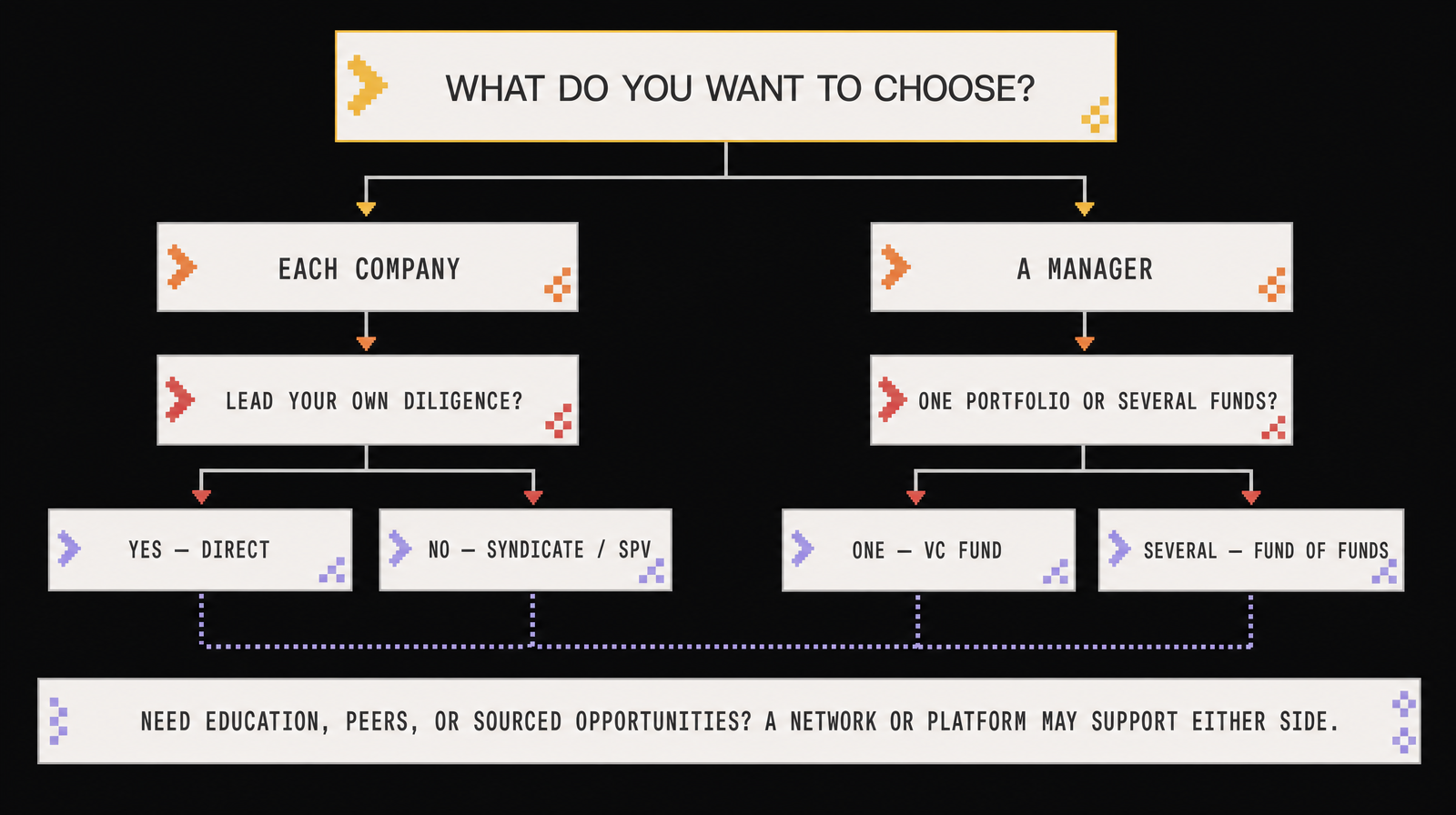
We'll compare four main ways to invest in venture capital:
- Direct startup investment. You choose a startup and buy a security issued by that company. The security might be a Simple Agreement for Future Equity (SAFE), convertible security, or preferred stock. Your rights come from the signed documents.
- Syndicate or single-deal SPV. A lead investor brings a startup opportunity to a group of backers. If you opt in, you typically buy an interest in a special purpose vehicle (SPV), and that vehicle holds the startup security. One SPV usually means exposure to one company.
- Venture fund. You buy a limited-partner (LP) interest in a pooled fund. You select the general partner (GP) after evaluating its strategy and terms; the GP chooses and manages the startup portfolio.
- Fund of funds. You invest in an outer fund. You select its manager, then delegate underlying-manager selection and company selection through two layers of investment decisions.

Compare the 4 venture-investing routes
Compare the routes by asking what you select, what you own, and which work you keep.
| Route | What you select | What you own | Typical cash pattern | Startup-selection control | Main tradeoff |
|---|---|---|---|---|---|
| Direct startup investment | A company and security | A security issued by one startup | Usually funded at closing; follow-ons are separate | You choose the company and security; post-close rights depend on the documents | Maximum choice, with company-level work and concentration |
| Syndicate or single-deal SPV | A lead and each offered deal | An interest in a single-company SPV | Deal by deal | You choose whether to join each deal; post-close rights are usually limited | Lead support and easier administration do not diversify a one-company vehicle |
| Venture fund | A manager, strategy, and fund terms | An LP interest in a pooled fund | A commitment followed by capital calls | Delegated to the GP | Delegation and a company portfolio, with manager, fee, and vintage risk |
| Fund of funds | An outer manager and mandate | An interest in an outer fund that holds interests in venture funds | Often a commitment followed by capital calls | Delegated through two manager layers | Broader manager exposure, with another cost and reporting layer |
Direct startup investing: the most deal choice and the most work
Direct investing gives you the clearest line between your decision and the company. You may be able to meet the founders, develop your own view of the market, and decide whether your operating experience or network could help.
You also remain responsible for more of the company-level process. You need to source opportunities, test the team's claims, review the cap table and financing terms, complete the paperwork, monitor the company, and decide whether to invest again in a later round.
The word “direct” does not promise a board seat, information rights, or pro rata rights. Those rights depend on the exact security and governing documents. Resale also depends on securities-law and contractual restrictions, required approvals, and whether a buyer exists. A smaller minimum may reduce the cash barrier for an eligible investor, but it does not make a one-company bet less concentrated.
Angel Squad is our angel-investing community for aspiring and active angels who want to build those skills with support. We teach the early-stage investing process we use at Hustle Fund, bring together founders and operators who can pressure-test a company, and share optional startup opportunities. You still decide whether to invest in each one.
Best suited to: founders, experienced operators, and sector specialists with strong startup networks, relevant company-building knowledge, and enough time to source and diligence each opportunity.
Syndicates and SPVs: choose each deal, with help from a lead
A syndicate and an SPV are related, but they are not the same thing. The syndicate is the investing relationship between a lead and backers. The SPV is the legal entity that pools their capital for a specific investment.
The lead may source the company, negotiate access, organize diligence, prepare an investment memo, and monitor the position. You decide whether to join that deal. If you do, you still need to evaluate three things: the company, the lead, and the vehicle.
Ask how much the lead is investing, what work the lead has done, how conflicts and allocations are handled, which fees and carried interest apply, and which rights pass through the SPV. Our guide to SPVs goes deeper into the legal wrapper and cap-table mechanics.
Best suited to: busy engineers, product leaders, executives, and other operators who have useful domain judgment but want a lead to source deals and organize the diligence and administration.
Venture funds: choose the manager, then delegate the deals
When you invest in a venture fund, your main decision moves from company selection to manager selection. You are backing a GP's thesis, team, access, portfolio construction, reserves, valuation policy, and judgment over the life of the fund.
Delegating sourcing, company diligence, monitoring, and follow-on decisions can reduce your workload. A single fund interest can also give you exposure to more companies than one direct investment or single-deal SPV. But company count alone does not remove concentration: the portfolio may still depend on one manager, strategy, sector, stage, and vintage year.
Fund commitments also require cash planning. Venture funds commonly accept commitments and call capital as needed. A $100,000 commitment may not leave your account on day one, but it can create a binding future obligation.
Review the manager's realized and unrealized performance, who produced it, how valuations are set, how follow-on reserves work, and what references from founders and existing LPs say. Then read the limited partnership agreement for fees, expenses, reporting, transfers, and default terms.
Best suited to: professionals and family-office investors who want a manager to build and oversee the company portfolio and who can plan for capital calls without reviewing every startup themselves.
Funds of funds: diversify across venture managers
A fund of funds adds another delegation layer. You choose the outer manager, the outer manager chooses venture funds, and those GPs choose the startups.
This can spread exposure across managers, strategies, and vintage years. It may also provide access to funds that a new LP could not reach alone. In return, you give up deal-by-deal company selection and add another link between a startup exit and cash reaching you.
Costs deserve special attention because you pay through both layers: the outer fund's expenses and, indirectly, the expenses of the underlying funds. Private fund-of-funds terms vary, so review the actual documents rather than assuming one standard fee model.
Best suited to: LPs with limited time or access to evaluate many venture managers directly who still want exposure across multiple funds, strategies, and vintage years.
Eligibility, minimums, capital calls, and fees
Check whether you can legally participate
Many private startup and fund offerings are limited to accredited investors. As of July 2026, the SEC's accredited-investor criteria include several routes, such as:
- Net worth above $1 million, excluding the value of a primary residence
- Income above $200,000 individually, or $300,000 with a spouse or spousal equivalent, in each of the prior two years, with a reasonable expectation of the same in the current year
- Certain securities licenses in good standing and, for investments in a private fund, knowledgeable employees of that fund
Accreditation is an access test, not a stamp of investment quality or suitability. Some funds apply additional eligibility tests; the offering documents control. Accreditation also is not required for every possible route. For example, Regulation Crowdfunding allows non-accredited investors to participate subject to aggregate 12-month investment limits, in transactions conducted online through an SEC-registered broker-dealer or funding portal.
Separate the minimum from the full obligation
Many direct deals and single-deal SPVs are funded at closing. A closed-end fund typically accepts a binding capital commitment and may call portions over time. The limited partnership agreement controls the timing and remedies, so keep liquid reserves for the full unfunded commitment. Before signing, confirm:
- The minimum commitment
- What is due now
- What can be called later
- How much notice you receive for a capital call
- What happens if you cannot fund it
- Whether you want to reserve capital for follow-on investments
Look through every fee layer
Use these numbers as reference points, not promises about a specific offering:
- Direct startup investment: If you buy a company security without a fund or SPV intermediary, there is no separate manager or administrator charging you management fees or carried interest. You may still pay your own legal or transaction costs.
- Syndicate or SPV: Separate the lead's carried interest from the vehicle's administration costs. As of July 2026, AngelList charges $8,000 to set up most SPVs plus $2,000 in state regulatory fees. Those vehicle-level costs are prorated across participating LPs. AngelList describes a 20% share of profits as standard lead carry, but the lead sets the actual rate.
- Venture fund: “2 and 20” is common shorthand for a 2% annual management fee on committed capital and 20% of profits as carried interest. It is not a rule: the fee base can change or step down, and the distribution waterfall determines how carry is calculated.
- Fund of funds: Add the outer fund's management fee, expenses, and possible carry to the fees and carry already charged inside the underlying venture funds. There is no single standard rate for the outer layer.
For every route, check the calculation base, timing, offsets, step-downs, expenses, and distribution waterfall in the documents.
Investors in SPVs and funds taxed as partnerships generally receive a Schedule K-1. Timing and state-filing consequences vary, so ask a qualified tax professional how the structure applies to your situation.
Is venture capital a good investment for you?
Venture capital can offer exposure to private companies with substantial growth ambitions. It also brings the possibility of total loss, limited disclosure, uncertain valuations, irregular cash flows, and a holding period with no dependable exit date.
Compared with public-market investments, you may receive less information. You could lose your entire investment, and you may not find a buyer when you want to sell.
Diversification changes where the risk sits; it does not make venture safe. One direct investment is concentrated in one company. Ten single-deal SPVs can still cluster around one sector or stage. One venture fund can hold many companies while remaining concentrated in one manager and vintage. A fund of funds can spread manager risk while adding fees and a longer path to liquidity.
Our co-founder and general partner Elizabeth Yin puts it plainly: “Don't try to pick a co. Select a portfolio.” Treat that as a portfolio discipline, not a formula for how many checks to write.
Set a venture budget that you can lose and leave illiquid. Pace commitments rather than letting one exciting deal determine the plan. Track exposure across companies, managers, sectors, stages, and vintage years.
Treat reported private-company values carefully too. A latest-round post-money valuation does not necessarily equal the value of every share class or what you could receive in a sale. Distinguish realized cash from unrealized marks and evaluate contractual rights rather than relying on a headline valuation.
Choose your route with 5 questions
The right starting point is your constraints, not a hot company name.
- What can you access? Check the offering exemption and eligibility rules in the documents.
- What do you want to choose? A company, a lead and deal, one fund manager, or a manager of managers?
- How much work do you want to keep? Direct deals require company-level sourcing and diligence. Funds delegate that work.
- Can you meet the cash pattern and wait? Compare a funded check with future capital calls, and assume you cannot sell on demand.
- Which concentration and costs are acceptable? Look through the full portfolio and every fee layer.
A diligence checklist before you invest
Convenience can reduce administration. It cannot replace diligence.
Company and security
- Who are the founders, and what do customers and references say?
- What evidence supports the problem, market, product, traction, and unit economics?
- What does the cap table show, and what rights attach to your security?
- How much cash does the company have, and what must happen before it raises again?
- Which legal, intellectual-property, regulatory, or compliance risks matter?
- What would have to be true for a plausible exit, and what could prevent it?
Lead or fund manager
- What is the investment thesis and sourcing advantage?
- Who made the decisions behind the track record?
- How much performance is realized cash versus unrealized marks?
- How are valuations, follow-on reserves, allocations, and conflicts handled?
- How much is the lead or GP committing?
- What do founders, LPs, and other references say?
Vehicle and administration
- What security or interest in an entity do you own, and what underlying asset does the entity hold?
- What is due now, and what can be called later?
- Which documents control voting, information, distributions, and transfers?
- What are the total direct and indirect costs?
- Who handles administration, tax documents, valuations, and reporting?
- What happens if the lead, manager, or platform changes or shuts down?
Write the answers in a short investment memo. Include a section called “What could break this thesis?” and decide what would make you pass before momentum takes over.
Take your first step
Write down three constraints before browsing deals: how much capital you can leave illiquid, how much time you want to spend, and which decisions you want to own. Then study several opportunities before committing to one.
If you want to learn by working through real early-stage deals with other investors, apply to Angel Squad. Our investor community teaches the framework we use at Hustle Fund, gives you a place to discuss companies with experienced operators and investors, and lets you choose whether to participate in curated startup opportunities. Every deal is optional.






.png)



.png)