
Waterfall modeling for startup exits: A step-by-step guide
A startup can sell for more than the money it raised and still leave some shareholders with little or nothing. The headline price is only the start. Debt, deal costs, liquidation preferences, participation rights, and conversion choices determine what reaches each holder.
This guide builds a simplified startup exit waterfall across five outcomes. The examples use common U.S. venture-company concepts, but real rights vary by company, instrument, transaction, and jurisdiction. Use the model for education and diligence, then have qualified legal, tax, and transaction advisers review any real deal.
What waterfall modeling means for a startup exit
Waterfall modeling calculates how the value available to equity holders would be distributed among security classes in a sale or other liquidity event. It starts with the relevant transaction proceeds, applies each claim in its contractual order, tests preferred-stock conversion choices, and distributes the remainder.
A cap table and an exit waterfall answer different questions:
- The cap table records who holds shares, options, warrants, Simple Agreements for Future Equity (SAFEs), notes, and other rights to equity.
- The waterfall applies the economic rights attached to those securities at a specific exit value.
That is why 10% of the fully diluted cap table does not always produce 10% of the sale proceeds. Common and preferred stock can carry different economic rights, as the Securities and Exchange Commission explains. The signed documents decide when those differences matter.
Our co-founder and general partner Elizabeth Yin describes one downside plainly: "you are at the bottom of the preference stack and later stage investors hose you." A waterfall turns that risk from a vague warning into testable math.
This meaning of waterfall modeling is unrelated to the sequential Waterfall method in software development. It is also different from the carried-interest waterfalls used between fund managers and limited partners or the promote structures used in real estate.
Gather the inputs before you open the spreadsheet
A reliable model begins with a source for every assumption. Gather these inputs before writing formulas.
Net value available to equity holders
Do not start with the number in the acquisition announcement. Build or request the bridge from headline transaction value to the cash and other consideration available for the equity waterfall.
Depending on the deal, that bridge may include cash on the balance sheet, debt payoffs, working-capital adjustments, transaction expenses, escrows, holdbacks, earnouts, rollover equity, and other negotiated items. A stock sale, merger, asset sale, secondary sale, and dissolution can treat those items differently.
For the worked example below, V means net cash available to equity holders after all upstream deductions. That keeps the shareholder math visible without pretending the headline price and equity proceeds are the same number.
A dated, reconciled ownership record
List issued common and preferred shares by class and series, then separately list every potential or contingent security. Include the current conversion ratio, not a blanket assumption that every preferred share converts one-for-one.
Also separate granted employee awards from the unallocated option pool. An unissued pool is not a shareholder and does not collect sale proceeds. Options and other awards may depend on vesting, acceleration, exercise price, withholding, and the acquisition agreement.
The economic terms for every preferred series
For each series, record:
- the original investment or contractual original issue price;
- the liquidation preference multiple;
- whether it ranks senior, junior, or pari passu (equal in priority) with other series;
- whether it is participating or non-participating;
- any participation cap and what the cap includes;
- its current preferred-to-common conversion ratio; and
- declared, accrued, or cumulative dividends that the documents add to the claim.
Our guide to liquidation preferences covers seniority, multiples, and participation in more detail. The waterfall's job is to combine those terms across the whole ownership structure.
SAFEs, notes, warrants, awards, and side letters
Do not turn every instrument into common stock just because it could eventually produce equity. The SEC distinguishes a SAFE, an agreement that promises a future ownership interest if a triggering event occurs, from a convertible note, which is a loan that may convert into another security.
Y Combinator's current SAFE documents contain separate financing, liquidity-event, and dissolution mechanics. Other SAFE forms and amendments can differ. Notes, warrants, and awards do not have one universal exit treatment. Use the signed instrument and transaction agreement to identify repayment, conversion, cash-out, exercise, assumption, replacement, or cancellation. A real SEC-filed merger agreement requires a consideration schedule that lists share classes, options, exercise prices, and holder-level payments, showing why treatment belongs at the security level.
Our co-founder and general partner Eric Bahn warns about the cap-table math behind stacked pre-money SAFEs: "It is really easy to mess up these calculations when you have so many different kinds of pre-money valuations stacking on top of each other..."
Inventory each signed instrument and amendment. Do not double count: model the payoff, conversion, or combination the signed instrument expressly requires.
The documents that control
For a Delaware corporation, state law allows classes to have different preferences, participation rights, and conversion rights, but those rights must be stated in the certificate of incorporation or an authorized designation. The Delaware statute provides the boundary; the company's current documents provide the numbers.
Reconcile the current charter and amendments with the stock ledger and cap table. Then trace every SAFE, note, option, warrant, side letter, and waiver into the definitive transaction agreement and closing funds flow. The NVCA model documents illustrate common clause choices, but NVCA itself says the forms are starting points that must be tailored.
Build the exit waterfall step by step
Use the same order every time so an assumption cannot disappear between scenarios.
- Start with V, the net value available to equity holders. Keep the bridge from headline price to V beside the model.
- Normalize the eligible share counts. Calculate the shares each security would receive under its actual conversion ratio. Keep cash-out instruments out of the as-converted denominator.
- Rank the preference claims. Pay senior tiers before junior tiers. Within a pari passu tier, allocate a shortfall under the governing formula, commonly in proportion to the preference amounts due rather than raw share count.
- Calculate each preference. A simple claim is the liquidation multiple multiplied by the applicable original issue price and outstanding shares, plus only the dividends or other amounts the documents include.
- Test every valid election. A non-participating series generally compares its preference with its as-converted payout. Participating preferred may take its preference and then share the residual until a cap applies. One series' election can change the pool and denominator for another, so complex models need to test valid combinations.
- Distribute the residual. Pay only the common, converted preferred, participating preferred, and other securities eligible under the selected outcome.
- Reconcile and sweep. Every class payout must be nonnegative and total exactly V. Run a range of exit values to find the points where preferences fill, common begins to receive value, a series converts, or a cap binds.
A worked startup exit waterfall example
The example is deliberately small enough to audit by hand while still showing seniority, participation, a cap, and two conversion decisions.
Assume the company has 10 million shares on an as-converted basis:
- Founders: 5.4 million common shares, or 54% as converted.
- Employees: 0.6 million common-share equivalents eligible for sale proceeds, or 6% as converted.
- Seed: 2 million preferred shares bought for $2 million. Seed has a 1x non-participating preference and converts one-for-one into common.
- Series A: 2 million preferred shares bought for $6 million. Series A has a senior 1x participating preference, a 2x cap on its total preferred payout, and one-for-one conversion.
Series A is senior to Seed. Its preference fills first. Seed then compares its $2 million preference with conversion. Series A can participate in the residual until its total preferred payout reaches $12 million, or convert entirely to common when 20% of V produces more.
Assume the operative charter lets each series receive its stated preferred result or its as-converted result, as modeled.
The employee amount is a modeling shortcut for common shares and awards that are eligible for proceeds. An unallocated pool would receive nothing. The examples also exclude taxes, later dilution, fees charged through an investment vehicle, contingent deal consideration, and any instruments not listed above.
The worked example groups those seven checks into five phases:
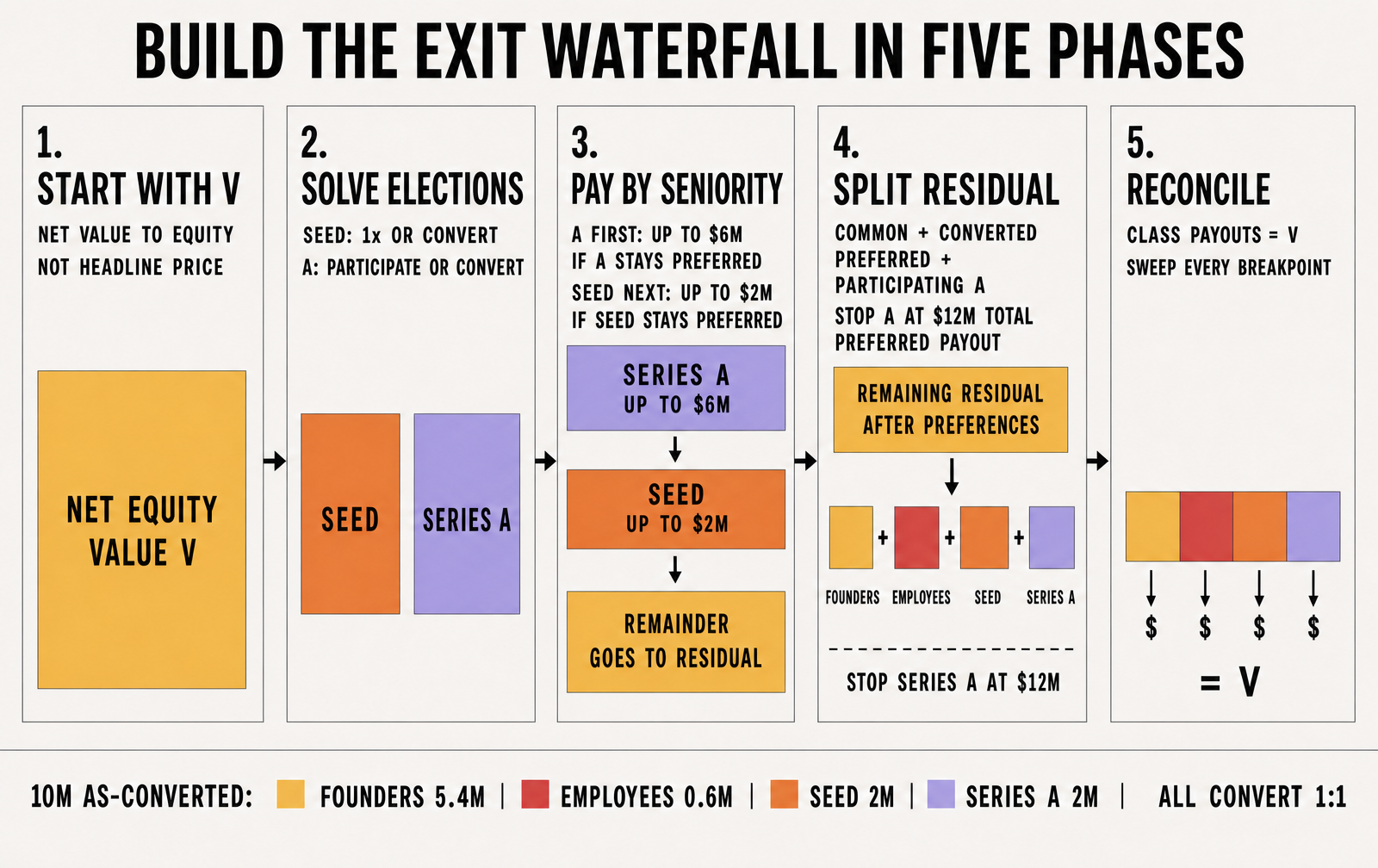
Seniority determines who is paid first; participation and conversion determine who shares the residual; the final class payouts must reconcile to net equity proceeds.
$5 million: the senior preference is not filled
Series A is entitled to receive up to $6 million before Seed or common under the assumed ranking. Only $5 million is available, so Series A receives all $5 million.
Seed, founders, and employees receive zero. Series A returns 0.83x its $6 million investment. A 1x preference gives payment priority; it does not guarantee that the full preference amount will be paid.
$10 million: both preferences are filled and Series A participates
Series A receives its $6 million preference. Seed takes its $2 million preference. That leaves a $2 million residual.
Seed is not participating, so it does not share that residual while taking its preference. The residual pool contains 2 million participating Series A shares and 6 million common shares. Series A receives 25%, or $0.5 million. Founders and employees split the other $1.5 million in proportion to their common shares.
The final payouts are:
- Series A: $6.5 million, or 1.08x invested capital.
- Seed: $2 million, or 1x.
- Founders: $1.35 million.
- Employees: $0.15 million.
The payouts total $10 million.
$20 million: Seed converts
Series A receives its $6 million preference, leaving $14 million.
If Seed stays preferred, it gets $2 million. If it converts, its 2 million shares receive 20% of the $14 million residual, or $2.8 million. Seed converts.
The residual is now shared across all 10 million as-converted or participating shares. Series A receives 20% of it, then adds its $6 million preference.
The final payouts are:
- Series A: $8.8 million, or 1.47x.
- Seed: $2.8 million, or 1.4x.
- Founders: $7.56 million.
- Employees: $0.84 million.
The payouts total $20 million.
$45 million: Series A is capped
Series A reaches its $12 million total preferred cap at a $36 million exit. Between $36 million and $60 million, it remains preferred but receives no more. The value above $36 million is shared among Seed, founders, and employees.
At $45 million, the final payouts are:
- Series A: $12 million, or 2x.
- Seed: $8.25 million, or 4.125x.
- Founders: $22.275 million.
- Employees: $2.475 million.
The payouts total $45 million.
$100 million: both series convert
At $100 million, Series A's 20% as-converted payout is $20 million. That beats its capped $12 million preferred payout, so it converts. Seed also converts.
The final payouts follow the as-converted ownership:
- Series A: $20 million, or 3.33x.
- Seed: $20 million, or 10x.
- Founders: $54 million.
- Employees: $6 million.
The payouts total $100 million.
Find the crossover points where payout rules change
The five examples are snapshots. These breakpoints show which payout rule applies between them.
- $6 million: Series A's senior 1x preference is full.
- $8 million: Seed's 1x preference is also full. Common begins to receive value only above this point.
- $16 million: Seed is indifferent between its $2 million preference and conversion. Above $16 million, conversion pays more.
- $36 million: Series A reaches its $12 million participation cap.
- $60 million: Series A is indifferent between the capped $12 million preferred payout and 20% as common. Above $60 million, it converts.
Those numbers are not industry benchmarks. They are outputs of this cap table and these terms. Change the preference rank, share count, participation rights, cap, conversion ratio, or value available to equity and the breakpoints move.
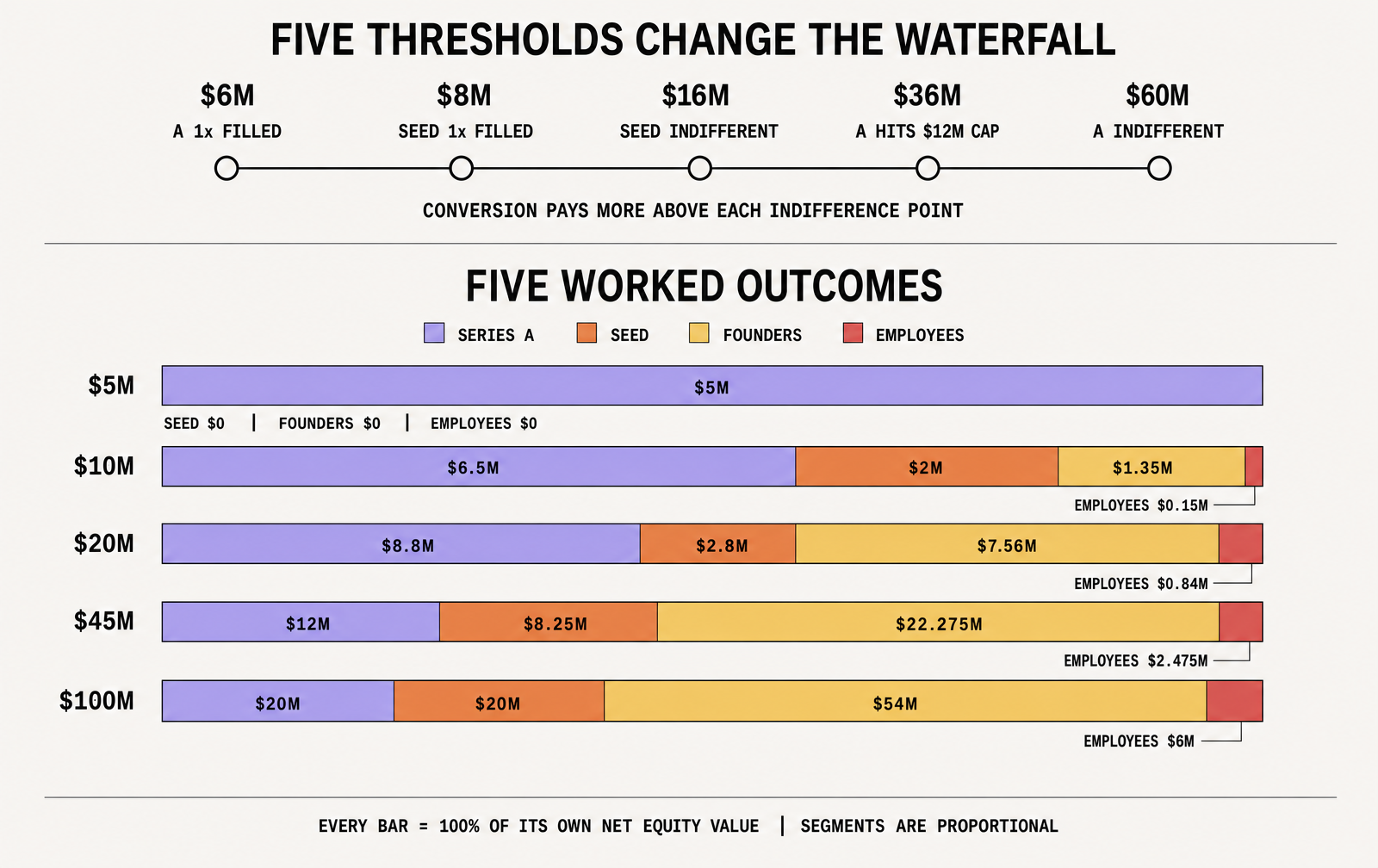
The active rule changes five times: the Series A preference fills, Seed fills, Seed converts, Series A reaches its cap, and Series A eventually converts. Each bar shows 100% of that scenario's net equity value.
Translate the class payout to your angel check
An angel commonly owns a fraction of a Seed class rather than the whole class. Translate the class output with one more calculation:
Angel payout = Seed class payout x angel's Seed shares / total Seed shares
Assume an angel supplied $100,000 of this $2 million Seed round on the same terms. The angel owns 5% of the Seed class. Across the five examples, the gross payouts are:
- $5 million exit: $0.
- $10 million exit: $100,000, or 1x.
- $20 million exit: $140,000, or 1.4x.
- $45 million exit: $412,500, or 4.125x.
- $100 million exit: $1 million, or 10x.
These are gross multiples on invested capital (MOIC), not annualized internal rates of return. They ignore the time to exit, taxes, follow-on checks, later dilution, fees or carry charged through a special purpose vehicle, and losses elsewhere in the investor's portfolio.
Record each assumption and case in an investment memo. Include the source documents, ownership date, and deal terms so another reader can reproduce the model.
Change one assumption at a time
A clean base case makes sensitivity analysis easier. Duplicate it, change one term, and compare the payout and breakpoint changes.
Senior versus pari passu preferences
The worked example gives Series A priority over Seed. That is why Series A receives the entire $5 million low-exit case.
If the two series ranked pari passu, an insufficient preference pool would commonly be shared in proportion to the amounts due under the governing formula. At $5 million, the result would be very different for Seed even though the cap table had not changed.
Participating versus non-participating preferred
Series A receives its preference and shares the residual because it is participating. If A were non-participating, it would choose between its preference and conversion, not both.
Participation is not a safe default assumption. In Cooley's sample of 165 reported venture financings in Q1 2026, 96.4% used nonparticipating preferred and 98.2% used a 1x preference. That is one law firm's deal sample, not a rule for a company or a future financing.
Participation caps
This example defines A's 2x cap as $12 million in total preferred proceeds, including the initial $6 million preference. Do not assume every shorthand "2x cap" works that way. Confirm the cap base, dividend treatment, and conversion right in the actual clause.
Conversion ratios and future dilution
The example uses one-for-one conversion. Stock splits, anti-dilution adjustments, down rounds, notes, SAFEs, warrants, and later financing can change the share count.
Model future dilution before relying on the original ownership percentage. A smaller percentage can still produce a larger payout if the company's value grows enough, but the waterfall should calculate that rather than assume it.
Dividends
Preferred dividends are not automatically 8% or automatically added to a liquidation claim. The governing documents decide whether they are cumulative, declared-only, simple, compounding, paid in cash or stock, and included in the preference or conversion comparison.
Employee awards
Replace the example's 0.6 million employee shortcut with award-level data. Check grant status, eligible shares, vesting, acceleration, strike price, withholding, and whether the buyer cashes out, assumes, replaces, or cancels each award.
Deal structure and timing
Cash at closing, buyer stock, escrow, holdbacks, earnouts, indemnity claims, and rollover equity may arrive at different times or carry different risks. Model them in separate cases when one blended number would hide the difference.
Waterfall-modeling checks that catch expensive mistakes
Run these checks before using the output in diligence, a board discussion, or a personal return estimate.
- Tie every input to a dated source. A label such as "Series A preferred" is not a preference clause.
- Reconcile eligible shares and instruments. The model should tie to the stock ledger, cap table, award records, and financing documents.
- Confirm every rank. Do not assume later investors are senior or all preferred is pari passu.
- Test every valid election. Preference, participation, conversion, cash-out, and cap logic can interact.
- Define every cap. State what it includes and how conversion changes it.
- Handle each SAFE, note, option, and warrant explicitly. No instrument should disappear into a generic fully diluted line.
- Reconcile each scenario to V. Resolve or explicitly allocate any rounding residual rather than leaving an unexplained gap.
- Test just below, at, and above every breakpoint. Payouts should not jump or fall without a documented reason.
- Separate gross proceeds from investor returns. MOIC, internal rate of return, taxes, vehicle fees, carry, and timing are different calculations.
- Get professional review. Qualified startup counsel, tax advisers, and the transaction team should validate a real model.
Inside Angel Squad, our angel-investing community, members learn Hustle Fund's investing frameworks, review optional startup opportunities, and discuss their reasoning with peers. Repeating a sourced checklist on real deals builds judgment; it does not make uncertain outcomes predictable.
The model is a decision aid, not the deal documents
The charter, stock ledger, SAFEs, notes, award documents, warrants, side letters, waivers, merger agreement, and closing funds flow answer different parts of the calculation. If they conflict, stop and resolve the discrepancy rather than forcing the spreadsheet to balance.
An exit waterfall estimates the contractual allocation of a defined pool. It does not predict whether a sale will happen, when consideration will arrive, whether an earnout will be earned, or what an individual will keep after taxes. Insolvency and bankruptcy also require specialist analysis rather than a normal venture cap-table waterfall.
The bottom line
Start with net equity value, encode the actual rights and eligible shares, test every valid election, and make the class payouts reconcile. Then sweep exit values until you can see where preferences fill, common begins to participate, caps bind, and conversion wins.
If you want to practice that kind of investor diligence with Hustle Fund's frameworks and a community of peers, apply to Angel Squad. Every opportunity is optional, and the decision remains yours.





.png)


.png)


.png)