
Investment memo template: a copyable guide for angel investors
An investment memo is a dated record of why you decided to invest in, pass on, or keep watching a startup. It turns a deck, calls, data-room files, and your own judgment into one case you can inspect before the wire and revisit later.
This is an investor's deal memo, not a founder's fundraising memo or a private placement memorandum (PPM). It is general education, not investment, legal, tax, or accounting advice. The examples use US documents and sources; rules vary by offering and jurisdiction. Copy the template as a working document, then have qualified advisers review the transaction and final documents before you sign or wire funds.
Copy this investment memo template
Start the memo alongside your startup due diligence, while questions are still open. For every important statement, use the same notation: [Status: verified fact / founder claim / investor assumption | Source: document or conversation | As of: date].
1. Decision snapshot
- Company: [Name]
- Memo date and author: [Date; name]
- Stage and round: [Pre-seed, seed, etc.; target round size]
- Decision: [Invest / Pass / Wait]
- Proposed check: [$]
- Instrument and headline terms: [Exact document and version; Simple Agreement for Future Equity (SAFE) post-money valuation cap/discount, note cap/discount/interest/maturity, or priced-round pre-money valuation and price per share]
- Estimated ownership: [% and assumptions, if calculable]
- Recommendation: [One sentence]
- Confidence: [Low / Medium / High, with reason]
2. Company, problem, and customer
- Company in one sentence: [What it sells, to whom, and the outcome]
- Ideal customer profile: [Specific company or consumer type]
- Buyer and user: [Who approves payment; who uses the product]
- Pain: [What happens today, how often, and what it costs]
- Current alternative: [Competitor, spreadsheet, service, internal tool, or doing nothing]
- Why now: [Behavioral, technical, regulatory, or market change]
- Evidence: [Customer calls, contracts, usage, research, or other source]
3. Product and differentiation
- Product today: [What exists now, not the roadmap]
- Workflow: [How a customer reaches value]
- Demo evidence: [What you observed; date]
- Differentiation: [Why customers choose it over each real alternative]
- Why it gets harder to copy: [Data, distribution, workflow lock-in, technical advantage, brand, or other mechanism]
- Dependencies: [Unbuilt features, integrations, approvals, suppliers, or other requirements]
4. Market and competition
- Initial market segment: [Narrow group of customers the company can win first]
- Bottom-up market estimate: [Number of plausible customers × annual revenue per customer]
- Key assumptions: [Adoption, price, geography, share, or expansion]
- Competitors and substitutes: [Direct, indirect, manual, and do-nothing options]
- Expansion path: [Adjacent customer, product, or geography]
- Investor assessment: [Why the wedge and expansion path are or are not credible]
5. Business model and go-to-market
- Revenue model: [Subscription, usage, transaction, hardware, services, etc.]
- Pricing and variable costs: [Current price; costs that rise with each customer or sale]
- Acquisition route: [Founder-led sales, product-led growth, partners, paid acquisition, etc.]
- Sales cycle: [Buyer steps and observed time]
- Repeatability: [What has worked more than once]
- Constraints: [Hiring, channel, capital, procurement, regulation, or implementation]
6. Traction and evidence
- Stage-appropriate proof: [Customers, paid pilots, retention, revenue, usage, waitlist conversion, experiments, technical milestones; status/source/as-of date]
- Trend: [Metric, period, cohort, and source]
- Quality: [Recurring versus one-off; organic versus paid; concentrated versus diversified]
- Customer evidence: [Reference-call findings, including disagreement]
- What is still too early to know: [Retention, pricing, sales efficiency, reliability, etc.]
7. Team
- Founders and roles: [Names; full-time status; ownership]
- Founder-market fit: [Relevant insight, access, or experience]
- Execution evidence: [What the team has shipped, sold, learned, or recruited]
- Working history: [How long and under what pressure the founders have worked together]
- Reference calls: [Who was called, relationship, and key findings]
- Gaps and hiring plan: [Missing capability; owner; timing]
- Investor assessment: [Why this team can or cannot clear the next major risks]
8. Financial position and use of funds
- Cash and debt: [$ as of date]
- Net monthly burn: [$ and calculation period]
- Runway: [Months before and after the raise; assumptions]
- Forecast: [Key revenue and cost drivers, not a pasted spreadsheet]
- Use of proceeds: [People, product, sales, compliance, or other categories]
- Milestone financed: [What this round should prove before the next raise]
- Stress case: [What happens if revenue is later or the next round takes longer]
9. Cap table and deal terms
- Current cap table: [Founders, employees/options, prior investors, advisors]
- Outstanding instruments: [Every SAFE, note, warrant, side letter, and material promise]
- New instrument: [Exact document and version]
- Round: [Target, committed, minimum close, lead]
- Economics: [Valuation or cap, discount, interest/maturity if applicable, option-pool treatment]
- Rights: [Pro rata, information, board, observer, or other rights]
- Estimated dilution and ownership: [Model and assumptions]
- Documents reviewed: [Links and date]
- Counsel questions: [Anything that needs qualified legal review]
10. Key risks and open questions
Rank the three to five risks that could actually break the thesis. For each one, complete the same fields:
- Failure mode: [Specific event or condition]
- Current evidence: [What supports or weakens the concern]
- Likelihood and confidence: [Estimate plus why confidence is limited]
- Impact: [What happens to growth, financing, ownership, or survival]
- Mitigation: [What the company or investor can do]
- Decision trigger: [Evidence that would change your recommendation]
Then list unfinished work:
- Open question: [Question]
- Owner: [Person responsible]
- Source needed: [Call, document, analysis]
- Deadline: [Date]
- Decision impact: [Invest / Pass / Wait consequence]
“The team needs to execute” is not a risk. “The two pilots must become annual contracts before the company runs out of cash” is.
11. Outcome cases
- Downside: [How the company fails; capital loss and timing]
- Base case: [What a plausible, non-heroic path looks like]
- Upside: [What must be true for an outlier outcome]
- Shared assumptions: [Growth, margins, financing, dilution, exit timing]
- Disconfirming evidence: [What would make each case less likely]
Keep the cases transparent and rough. A precise multiple built on unknowable adoption, financing, dilution, and exit assumptions is still a guess with more decimal places.
12. Portfolio fit and check size
- Thesis fit: [Sector, stage, geography, ownership, impact, or other rule]
- Concentration: [Exposure after this check]
- Reserve implication: [Whether follow-on capital may be needed]
- Opportunity cost: [What this check prevents you from doing]
- Loss capacity: [Whether a total loss fits the portfolio plan]
- Recommended check: [$ and reason]
13. Final recommendation
- Decision: [Invest / Pass / Wait]
- Amount and conditions: [$; documents, milestones, or allocation conditions]
- Two decisive reasons: [1; 2]
- Why this decision could be wrong: [Strongest counterargument]
- Next review: [Date or event]
Write the decision plainly. “Wait until retention is measurable” is better than hiding indecision inside another page of market analysis.
14. Sources and change log
List the deck, data-room files, product demo, founder calls, customer calls, reference calls, cap-table model, financing documents, and external research used. Use access-controlled links, record confidentiality or use restrictions, and identify who may view each file. Do not copy sensitive personal, customer, or company information into the memo unless it is necessary and you are permitted to retain it.
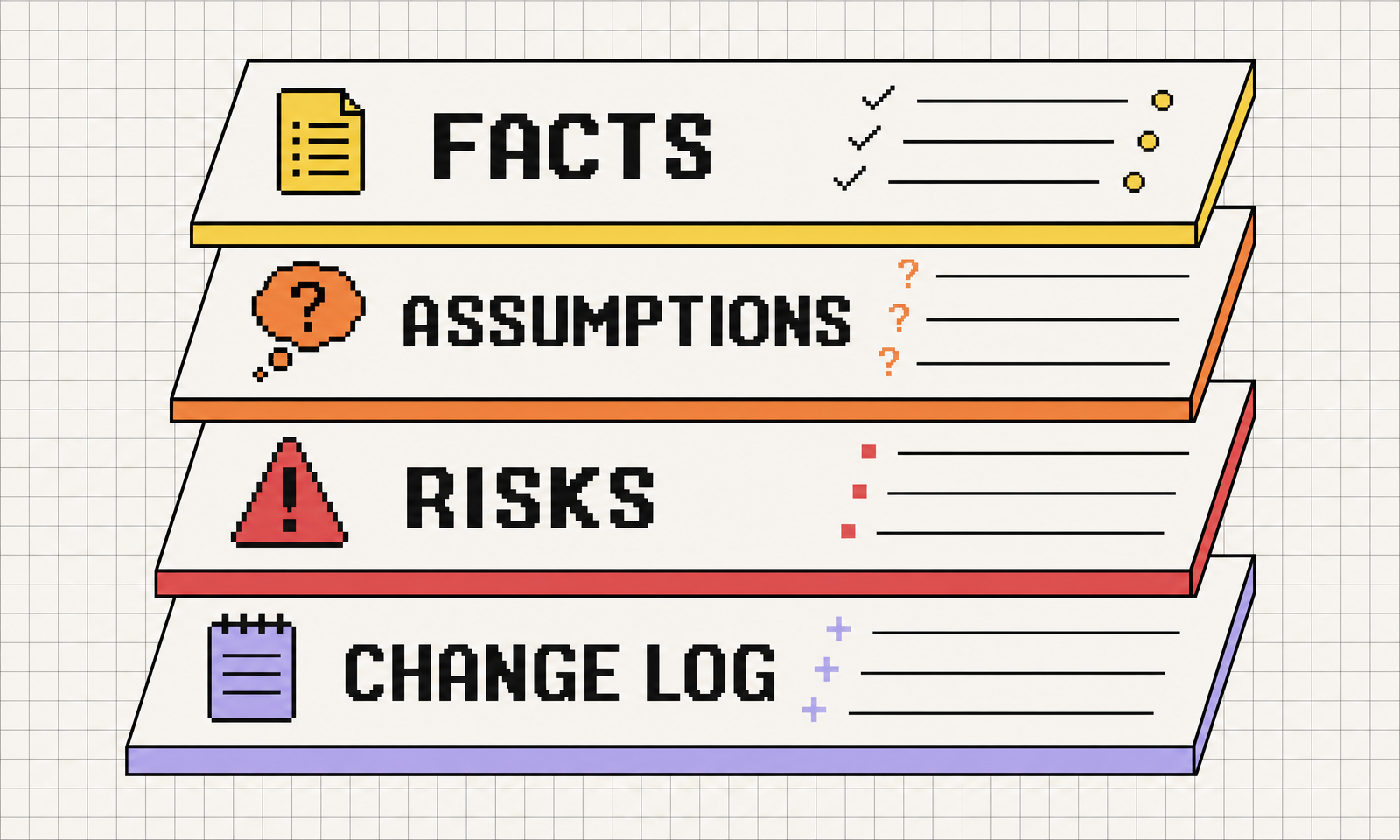
Append material changes below the original memo:
- Date: [Date]
- New fact and source: [What changed; link]
- Affected assumption or risk: [Which one]
- Decision impact: [No change / Invest / Pass / Wait / Check-size change]
- Author: [Name]
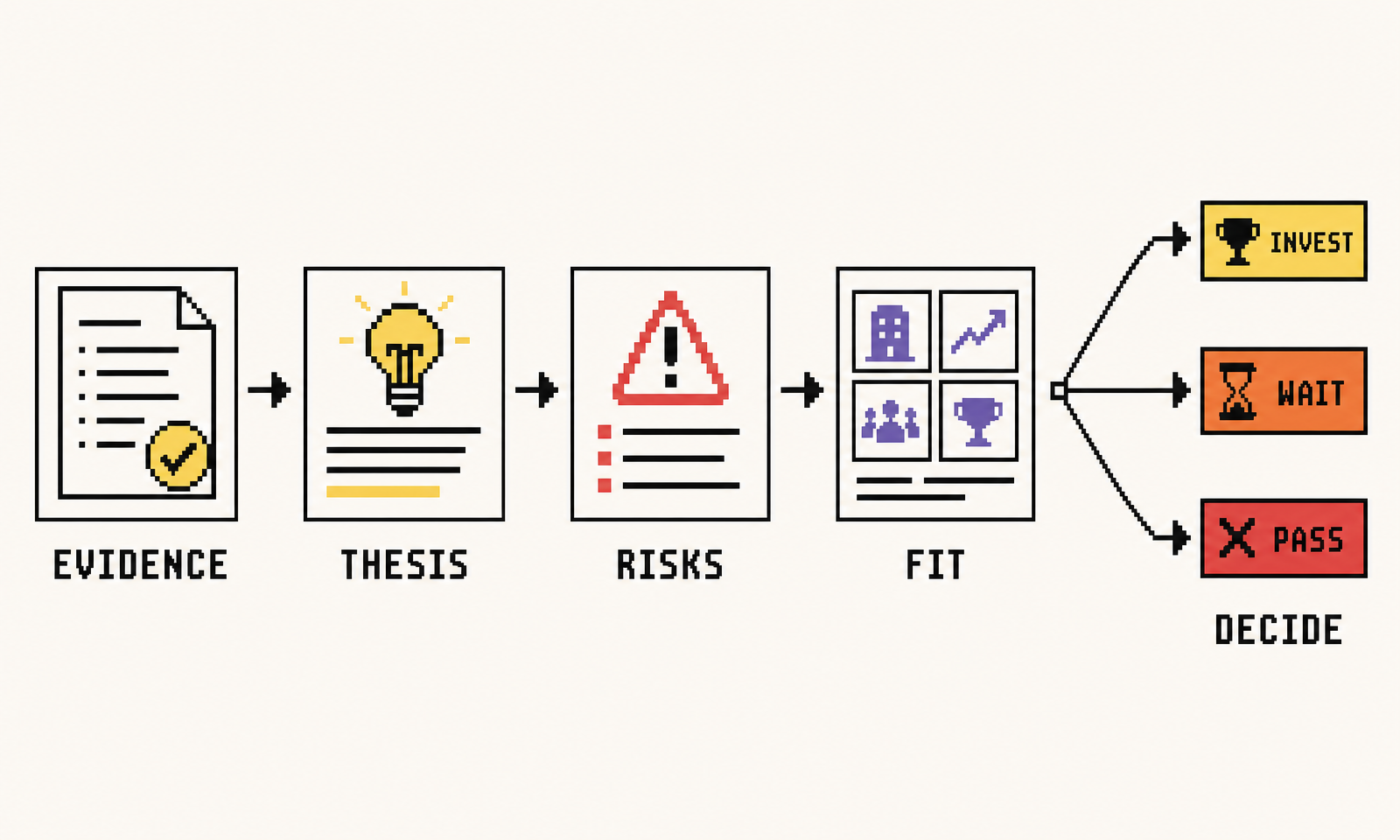
How to write a memo that survives scrutiny
A standard format makes omissions easier to spot. A survey of 54 investment organizations found that 97% used investment memos and 86% used standard templates. That does not prove memos create better returns; it shows that consistent decision records are common among the professional investors surveyed.
Five habits make the record more useful:
- Write the recommendation first. Treat it as a draft to test, not a verdict to defend. If the evidence changes the answer, change the recommendation before you sign.
- Separate fact from belief. “Three customers signed pilot agreements requiring payment” is verified if you reviewed the executed contracts. “All three have paid” requires collection evidence. “Those pilots will convert” is an assumption. Keep each statement, but do not blend them.
- Match the proof to the stage. Early traction may be customer discovery, presales, a credible waitlist, or rapid experimentation. Later, comparable-cohort retention, sales efficiency, and gross margin (the percentage of revenue left after direct costs) should carry more weight.
- Make risks falsifiable. Name the failure mode, the evidence you have, and the result that would change your mind.
- Link the evidence instead of pasting it. The memo is the decision layer. Contracts, call notes, spreadsheets, and legal documents belong in the supporting file set.
Use the evidence that matches the business. A pre-seed enterprise startup may have paid pilots and a credible pipeline, while a consumer product may need repeat usage and retention. One universal revenue benchmark will misread both.
Give the team section the same discipline. In a survey of 885 institutional venture capitalists at 681 firms, respondents rated the management team above product or technology in investment selection. The result does not make team quality objectively measurable, but it explains why the section deserves evidence rather than a résumé summary. (National Bureau of Economic Research)
Our co-founder and general partner Eric Bahn puts the emphasis on people: “Pre-seed investing and seed investing is largely an exercise of assessing the potential of the founders.” Our co-founder and general partner Elizabeth Yin offers a counterweight: “Of course, a great team matters, but an amazing idea matters way more.” Both lenses belong in the memo: record evidence of founder execution and market pull instead of letting one strong signal decide the case.
Record terms precisely, too. “SAFE” is not a complete description: As of July 2026, Y Combinator publishes three US post-money SAFE forms and an optional pro rata side letter. (Y Combinator SAFE documents) A compelling company can also be the wrong investment for your portfolio. The SEC notes that securities issued through private offerings are often illiquid and, depending on how they were sold, may be restricted and not freely tradable. Size the check for both loss and liquidity risk.
In Angel Squad, our angel-investing community, every startup opportunity we share includes a memo covering the company, founders, terms, and investment thesis; each member decides deal by deal whether to invest. Use that memo as a starting point, not a substitute for your own evidence labels, open questions, and portfolio-fit check.
The goal is not to make every memo look identical. It is to ask the same hard questions before excitement, urgency, or a persuasive founder chooses which questions you skip.
Worked investment memo example
HarborTrack is fictional. Every name, number, customer, and term below exists only to demonstrate the template. Nothing in this example is a recommendation or benchmark.
Decision snapshot
- Company: HarborTrack
- Memo date: July 27, 2026
- Stage and round: Pre-seed; raising $1 million
- Decision: Wait
- Proposed check: $10,000 if conditions are met
- Instrument: Post-money SAFE with an $8 million valuation cap and no discount
- Estimated ownership: If this is the current YC US post-money valuation-cap form and the cap applies, the $10,000 check implies about 0.125% on a post-SAFE, as-converted basis ($10,000 ÷ $8,000,000), before dilution from the later priced round and any option-pool increase adopted with it. This is not current stock ownership; confirm the exact form, executed terms, and capitalization model before investing.
- Recommendation: Revisit after at least two of three paid pilots convert to 12-month contracts and the cap table is reconciled.
- Confidence: Medium. Customer pain looks credible, but retention and ownership are unresolved.
Company, problem, and product
HarborTrack sells compliance-workflow software to independent cold-storage warehouse operators. Operations teams record temperature checks, inspections, and incidents across paper forms and spreadsheets; the buyer is the operations or compliance lead, while floor supervisors do the daily work.
The current product lets supervisors capture checks on a phone and gives managers an audit-ready log. In the demo, the basic inspection and exception workflow worked. The export required by one pilot customer was still being built. Those statements are verified only for the demonstrated test environment, not at production scale.
The alternatives are paper, spreadsheets, generic warehouse software, and doing nothing until an audit forces the issue. HarborTrack's claimed advantage is faster setup for small operators that do not want a full warehouse-management-system replacement. That positioning came from founder and pilot-customer calls; it is not yet proven by renewal behavior.
Market, model, and go-to-market
The initial wedge is independent US cold-storage warehouses with a compliance lead but no dedicated software administrator. The founders supplied a list of 2,400 possible locations. The memo should not treat that list as a verified customer count until its source and exclusions are checked.
At the pilot price of $500 per location per month, 2,400 locations would represent $14.4 million in annual recurring revenue before adoption, churn, discounts, or expansion. That is arithmetic, not a forecast. The company needs a credible path into adjacent audit workflows or larger operators if the initial wedge proves too small.
HarborTrack uses founder-led sales through two industry consultants. Three pilots came from 19 qualified conversations. No channel has produced repeatable annual contracts, so acquisition cost and sales-cycle claims remain assumptions.
Traction, team, and finances
Founder claim: three customers are paying for pilots across five sites. The investor reviewed signed pilot agreements but not bank or ledger records, so collection remains unverified. Usage exports show supervisors at two customers used the product weekly during week 12; the third customer had no usage after a reported staffing-related rollout delay. No pilot has reached renewal or annual conversion.
The CEO previously ran operations for a regional warehouse operator. The technical co-founder built internal workflow products at a logistics software company. They have worked together for nine months and shipped the pilot product in four. That supports domain access and speed, but not yet their ability to build a repeatable sales team.
The company reported $310,000 in cash at June 30 and $42,000 in June net cash burn. Dividing cash by that one-month burn gives about 7.4 months of runway. If the full $1 million round closes, $1.31 million of pro forma cash equals about 31.2 months at the same burn before financing costs; planned hiring and implementation spend makes that a sensitivity, not a forecast. The founders intend to fund pilot exports and integrations, one implementation hire, and the annual-conversion test. Obtain monthly cash history and a post-raise downside budget showing whether cash lasts through that milestone and a financing buffer.
Cap table and terms
The founder supplied a pro forma, as-converted summary before this new SAFE round: founders 84%, employee option pool 10%, advisors 1%, and prior SAFE holders 5%. It sums to 100%, but it is not the current issued-and-outstanding cap table; its accuracy depends on each prior instrument and the option-pool definition.
If the full $1 million round closes on the same $8 million YC post-money cap and the cap applies, the new SAFEs represent about 12.5% on a post-SAFE, as-converted basis ($1 million ÷ $8 million), before dilution from the next priced round. Reconcile every executed SAFE, note, option grant, warrant, and side letter, and model different SAFE forms separately. No separate pro rata side letter or information-rights agreement was provided; have counsel review the final documents.
Key risks and open questions
- Pilot conversion: The core risk is that teams will use the product during a supported pilot but will not sign annual contracts. Two annual conversions would improve the evidence; zero would break the current thesis.
- Implementation load: Custom exports may turn a software product into services work. Track hours per launch and whether the same integration can serve multiple customers.
- Market wedge: The initial segment may be too small. Verify the location list, annual contract value, and adjacent workflow demand.
- Sales bottleneck: Both founders are required for every deal. A second repeatable source of qualified opportunities would reduce this risk.
- Ownership uncertainty: The cap table summary may not reflect all SAFE and option-pool dilution. Do not size the check from the headline cap alone.
Open work: speak with the delayed pilot, obtain bank or ledger evidence of pilot payments and refreshed usage exports, reconcile the cap table, and document the source of the 2,400-location estimate.
Evidence record (fictional):
- Verified fact: Weekly use at two pilot customers | Source: product usage export | As of: July 24, 2026.
- Founder claim: 2,400 possible locations | Source: founder market list; underlying source not yet checked | As of: July 20, 2026.
- Investor assumption: Two annual conversions would justify revisiting | Source: investor judgment | As of: July 27, 2026.
Sources reviewed (fictional): Product demo; founder calls; three pilot agreements; 12-week usage export; June cash and burn report; draft post-money SAFE; cap table summary.
Change log: No updates yet. Original wait decision frozen July 27, 2026.
Outcome cases, portfolio fit, and recommendation
- Downside: Pilots do not convert, custom work consumes cash, and the company cannot raise again. The investment could become illiquid and lose its full value.
- Base case: Two pilots convert, founder-led sales works in one narrow segment, and another round is required before acquisition becomes repeatable. Later dilution could be substantial.
- Upside: The initial workflow becomes the entry point to multiple audit and compliance products across many sites. That requires conversion, retention, implementation efficiency, and an expansion path that are not yet proven.
Portfolio fit is unresolved: the example has not stated the investor's total angel allocation, maximum single-company exposure, or follow-on reserve, so it cannot yet conclude that a $10,000 check fits. The current decision is wait, with a review on September 15, 2026, or earlier if two pilots sign annual contracts. The strongest counterargument is that the round could fill before those results arrive. Scarcity does not resolve the evidence gap.
Update the memo without rewriting history
Freeze the memo you used for the decision. When something material changes, append an entry rather than editing the old claim until it looks prescient. Our guide to why deal memos matter goes deeper on that review habit.
An update needs four things:
- The new fact and its source.
- The assumption or risk it changes.
- The effect on the decision or check size.
- The date and author.
Update before signing if terms or capitalization change. After investing, revisit the memo when a major financing, product, team, or customer event challenges the thesis, and at whatever portfolio-review cadence you can sustain. The original memo remains the baseline.
Bessemer's public Shopify investment memo shows why this matters: the original evidence and concerns remain visible alongside later commentary about what happened. The record becomes useless if hindsight replaces the earlier view.
A memo improves the process, not the odds
A polished memo cannot make an early-stage company predictable. It can show what you verified, what you assumed, which risks you accepted, and why this check belonged in your portfolio.
That discipline gets stronger with repetition and honest disagreement. Angel Squad pairs Hustle Fund-led investing education with a community of other angels. If you want more practice turning diligence into decisions, apply to join us.







.png)


.png)