
Investment risk tolerance: how much risk can you really take?
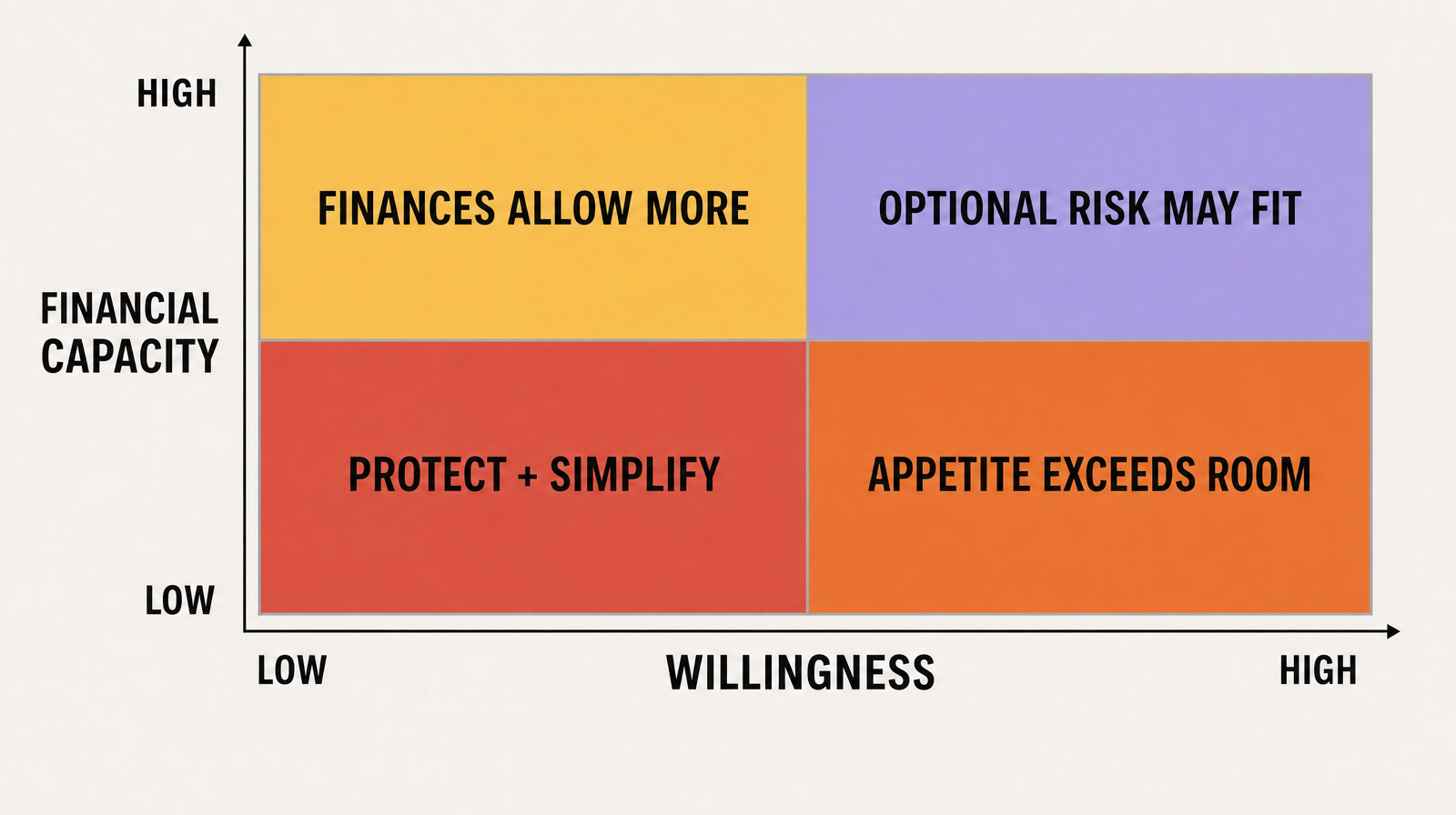
Feeling calm about investment risk is only half the answer. You also need the financial room to absorb a loss without missing a goal, selling at the worst time, or putting essential money in danger.
That is why a useful investment risk tolerance assessment separates what you want to do from what your finances can support. The self-check below helps you work through both sides without pretending that one quiz score can prescribe your portfolio.
What investment risk tolerance actually means
Investment risk tolerance is the amount of uncertainty and loss you are willing and able to accept while pursuing a potential return. FINRA's definition includes both parts: willingness and ability.
Organizations use the terms differently. FINRA uses risk tolerance broadly for risk you are willing and able to accept. Some frameworks reserve risk tolerance for willingness and treat capacity as a separate input.
Those parts can disagree.
You may feel unfazed by a market drop but still need the money for a home purchase in two years. Or you may have secure finances and a 20-year horizon but know that a volatile account would keep you awake and tempt you to sell.
In either case, the right answer is not the boldest label you can tolerate in theory. It is the level of risk that fits the goal and that you can live with through an ugly outcome.
Separate four inputs in your risk profile
Treating risk tolerance as one number hides important differences. For this self-check, separate four inputs.
1. Willingness to take risk
Willingness is your reasoned comfort with uncertainty and potential loss. It is one thing many risk-tolerance questionnaires aim to measure, but tools vary and may mix in time horizon, capacity, or other concepts.
Ask yourself what level of decline you could watch without abandoning the plan. Try to answer based on a bad year, not the confidence you feel when markets are rising.
2. Capacity to take risk
Risk capacity is your financial ability to absorb a loss and still meet your obligations. Time horizon, cash reserves, income stability, debt, dependents, and the importance of the goal all matter.
CFA Institute research makes the distinction plainly: willingness can be high while capacity is low. Capacity is the hard ceiling because a portfolio should not put necessary future spending at risk just to match an adventurous personality.
3. Need to take risk
Risk need is the amount of investment return a goal appears to require. Suppose your current savings and contributions are unlikely to reach the target without strong growth. That creates a gap. It does not create permission to take unlimited risk.
When the required return exceeds your willingness or capacity, change the plan rather than force the portfolio: save more, spend less, extend the timeline, reduce the goal, or get individualized advice.
4. Behavior under stress
Your stated tolerance is what you say you will do. Your behavior is what happens when the loss is real.
Short-term fear, recent gains, overconfidence, and unfamiliarity can all affect a decision. That reaction is useful evidence, but it is not always a stable description of you. A written plan helps keep a scary week from rewriting a 20-year strategy.
A seven-question investment risk tolerance self-check
Do not total up points. Answer each question in writing and look for the weakest constraint. One hard "no" can matter more than six confident answers.
1. What is this money for?
Name the goal and the cost of missing it. Retirement income, tuition, a home deposit, and optional wealth building do not carry the same consequences.
The more essential the goal, the less room you have to accept an outcome that puts it out of reach. Assess each goal separately instead of giving your entire financial life one risk label.
2. When might you need the money?
Use the earliest realistic date, not the date you hope to leave the money invested.
A long horizon provides more time to recover from public-market declines. A short horizon raises the chance that you will have to sell while prices are down. Investor.gov uses goals of five years or less as an example of when risky investments can create that problem. It is a prompt, not a universal cutoff.
3. Could anything force you to sell?
Check your emergency savings, job and income stability, debt payments, insurance, dependents, and expected large expenses.
This question is about liquidity, meaning your ability to turn an investment into usable cash without a major loss or delay. If one car repair or a few months without income would force a sale, your practical capacity is lower than your long-term ambition suggests.
4. How much permanent loss can the plan absorb?
Convert the percentage into dollars. A 20% decline in a $25,000 account is $5,000. In a $500,000 account, it is $100,000.
Then separate a temporary price decline from a permanent loss. A diversified public-market fund may fall and later recover; an individual company can fail and never return your money. Your plan has to survive the relevant kind of loss.
5. What would you do after a sharp decline?
Imagine your portfolio falls 30% and stays down for a year. Fidelity uses a similar 30% stress scenario in its current risk-tolerance guidance.
Would you:
- sell everything to stop the pain;
- reduce risk even if that meant locking in a loss;
- hold the plan but feel persistent anxiety; or
- keep following the plan without needing to make a major change?
There is no prize for picking the bravest response. The point is to choose a strategy you are likely to keep when the hypothetical decline shows up in your actual account.
6. Where are you already concentrated?
Look beyond the account in front of you. Your salary, employer stock, home, carried interest, private-company equity, and investments may depend on the same sector or economic outcome.
Five technology holdings are not five independent bets if they tend to fall for the same reason. FINRA's guidance on concentration risk recommends looking through fund holdings, checking for correlated exposures, and separately considering how much of your portfolio is tied up in illiquid investments such as private placements.
7. Could a private investment go to zero and stay locked up?
Private-company and startup investments need a stricter version of the test:
- Could you lose the entire check without changing your lifestyle or an essential goal?
- Could the money remain unavailable for an indefinite period?
- Could you live with sparse updates and no reliable day-to-day market price?
If any answer is no, the investment exceeds at least one constraint. A high appetite for risk does not repair a liquidity or capacity problem.
What conservative, moderate, and aggressive labels miss
Risk questionnaires commonly place investors in three broad groups:
- Conservative: prioritizes stability and accepts lower expected growth to limit losses and volatility.
- Moderate: accepts some fluctuation while balancing growth with stability.
- Aggressive: accepts larger swings and potential losses in pursuit of higher long-term growth.
These labels compress several inputs into one shorthand. The label alone cannot show which constraint drove the result or prescribe an allocation. Check whether the tool measured willingness alone or also included capacity, time horizon, and other factors.
Consider two people:
- High willingness, low capacity: A founder loves risk but has most of their wealth tied to one private company and expects a large tax bill next year. Their finances set a lower ceiling than their personality.
- Low willingness, high capacity: An executive has stable income, cash reserves, and a long horizon but hates seeing losses. Their finances could support risk, but an aggressive plan may fail if they abandon it during a decline.
Neither person needs a more flattering label. They need guardrails that respect both constraints.
Turn your answers into investing guardrails
An assessment is useful only if it changes what you do next.
Separate money by goal
Create distinct buckets for essential near-term spending, long-term goals, and genuinely optional capital. Each bucket can have a different horizon and different loss capacity.
Cash needed for an emergency or a near-term purchase should not depend on selling a volatile or illiquid asset at the right moment. Long-term capital can be evaluated differently because there is more time and flexibility.
Let the lower constraint win
When willingness and capacity disagree, do not average them. Use the more restrictive answer as the current ceiling.
That rule also works for risk need. A goal that seems to require a very high return is a reason to revisit the goal and savings plan, not to ignore loss capacity.
Design for the bad day
Write down three decisions before you invest:
- the largest loss the goal can absorb;
- the conditions that would justify changing the plan; and
- what you will do after a large decline if those conditions have not changed.
This is not a promise to hold every investment forever. It is a way to distinguish new information from fear.
Check the whole portfolio
Set limits for exposures that can compound each other. If your career and existing wealth already depend on startups or one industry, another private-company check adds to that same risk.
Diversification cannot prevent loss, but it can reduce how much one company or one theme controls the result. Our deeper look at the portfolio concentration trade-off covers that decision in more detail.
For startup exposure, a broader set of small positions can also create more chances to learn. Hustle Fund co-founder and general partner Eric Bahn's advice to beginners is: “For beginners, a bigger startup portfolio is better. It helps with diversification and helps you learn and get reps in.” That principle applies only after the capital passes the full-loss and illiquidity tests. Diversification does not make an unaffordable allocation affordable.
Use a quiz as a starting point
A research-based questionnaire can expose inconsistencies in how you think about risk. The University of Missouri assessment is one option.
Do not treat the score as a verdict. CFA Institute's psychometric review says a risk-tolerance score should start a planning discussion. It does not replace a review of goals, spending needs, liquidity, or the investments themselves.
Reassess after a real change
Review your answers when your job, income, debt, family responsibilities, health, goal, or time horizon changes. A new dependence on the invested money can lower capacity even when your personality stays the same.
Market headlines alone are not a reason to reinvent your profile. A change in your life or plan is.
Startup investing needs a stricter test
Public-market risk quizzes usually show fluctuating portfolios of stocks, bonds, and cash. Startup investing adds risks those models do not capture well.
The SEC warns that startup and early-stage investments made through Regulation Crowdfunding are speculative, often fail, and can result in a total loss. It separately warns that private placements can be high risk, highly illiquid, and subject to less disclosure than registered offerings. Our guide to startup exits goes deeper on how to plan for liquidity rather than assume a sale date.
Hustle Fund co-founder and general partner Elizabeth Yin puts the consequence plainly: “Most of your investments will return $0. You will lose money. So it's important to have great portfolio construction.” Portfolio construction can spread company-specific risk; it cannot eliminate loss or create liquidity.
That changes the self-check:
- Loss capacity: Treat each startup check as if it could return $0.
- Liquidity capacity: Do not assign money that may be needed on a fixed date.
- Concentration: Count startup equity from your job, advisory work, funds, and direct investments together.
- Behavior: Prepare for long quiet periods and incomplete information. Private-market stress does not arrive as a visible daily price change.
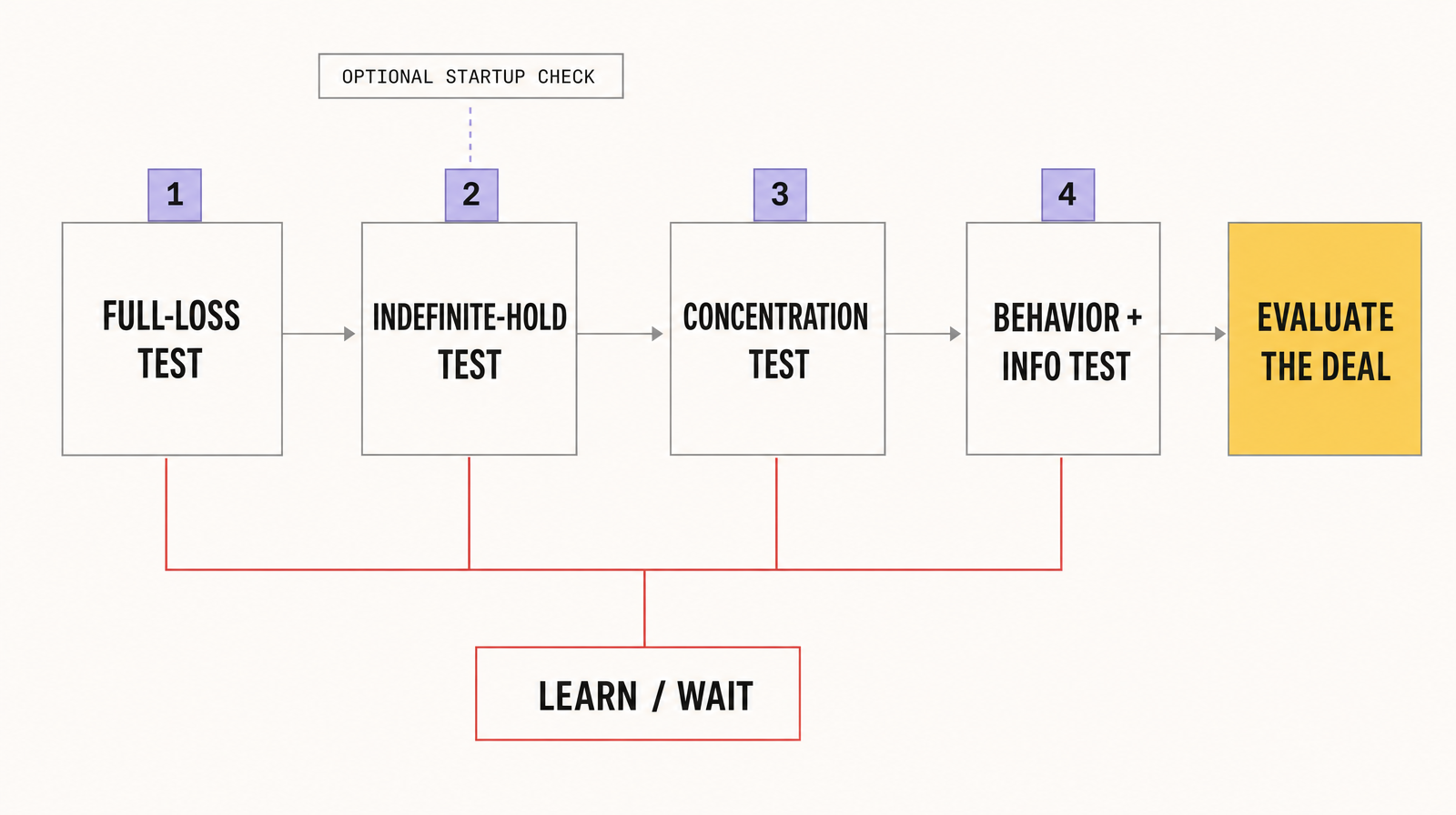
If those conditions fit, decide how private exposure fits your wider portfolio and pace your deployment. If they do not fit, learning without investing is a valid decision.
In Angel Squad, our angel-investing community, every deal is optional. Members can use the education and community without treating access to an opportunity as a reason to invest. That separation matters: a community can improve your process, but it cannot make an unsuitable check suitable or remove venture capital risk.
When to get a second set of eyes
Consider a registered investment professional when:
- your willingness and capacity point in opposite directions;
- the return your goal appears to need is unusually high;
- several goals compete for the same money;
- taxes, private-company equity, debt, or family obligations make the full picture hard to see; or
- you are considering a private commitment that would materially affect your liquidity.
Ask how the professional is paid, what conflicts may exist, and whether the recommendation considers your whole financial situation. Before hiring anyone, check their registration and disciplinary history, and read the firm's Form CRS (customer relationship summary).
This guide is general education, not individualized investment, legal, or tax advice or a recommendation to buy, sell, or hold a security. Investing involves loss of principal. Startup investments are speculative and can result in a total loss. Private placements may be highly illiquid, and investors may need to hold them indefinitely.
The practical rule
Your capacity sets the ceiling. Your willingness determines what you can stick with. The return you need does not get to overrule either one.
If you have genuinely surplus, long-horizon capital and want to build your startup-investing judgment before deciding on optional deals, apply to Angel Squad. We help aspiring and active angels learn from Hustle Fund's experience, review opportunities, and compare notes with other investors. The decision to invest remains yours, one deal at a time.






.png)



.png)