
What Is SEC Form C? An Investor's Guide to Reading It
A polished campaign page can explain why a startup wants your money. SEC Form C shows what the company is offering, who controls it, how it describes its finances and risks, and what rights your security may actually carry.
That makes Form C the starting point for evaluating a Regulation Crowdfunding investment. It is not an SEC endorsement, and it is not a substitute for independent diligence.
What is SEC Form C?
Form C is the offering statement a company files with the U.S. Securities and Exchange Commission before it begins a securities offering under Regulation Crowdfunding, often called Reg CF. The filing gives investors public information about the company, offering, security, financial condition, ownership, use of proceeds, and risks.
This guide is about the SEC filing, not IRS Schedule C.
The issuer files Form C through the SEC's Electronic Data Gathering, Analysis, and Retrieval system, better known as EDGAR, and provides it to the registered broker-dealer or funding portal running the offering. The intermediary must make the information public and downloadable on its platform for at least 21 days before securities are sold, although it may accept investment commitments during that review period. The current Form C and its instructions run 26 pages.
Regulation Crowdfunding lets an eligible issuer raise up to $5 million in a rolling 12-month period through one registered online intermediary. If you need the wider context first, read our guide to how equity crowdfunding works.
The SEC's required legend is blunt: the agency has not passed on the merits or terms of the offering, confirmed the filing's accuracy or completeness, or independently determined that the exemption is available. A filed form is disclosure supplied by the issuer, not approval.
Rules note: The regulatory figures and filing rules in this guide were checked on July 31, 2026. The current eCFR compilation available that day was updated through July 29, 2026, and no intervening final SEC rule changing these provisions was found. Securities rules and SEC forms can change, so check the current primary sources and get qualified advice for a specific transaction. This guide is general education, not legal, tax, or investment advice.
Where to find a Form C in EDGAR
Start with the SEC's company filing search. Search the issuer's exact legal name, not just the brand on the campaign page. A Central Index Key, or CIK, is even better because it uniquely identifies the filer.
Then build the filing trail:
- Open the initial Form C filing.
- Open the filing index, then review the structured primary document and every relevant exhibit. The risk factors, financial statements, security instrument, subscription agreement, and other narrative may sit in attachments rather than the cover page.
- Collect every later Form C/A, C-U, C-AR, C-AR/A, C-TR, and C-W filing.
- Put the documents in date order and note what changed. An amendment may update only part of the earlier disclosure.
- Compare EDGAR with the live campaign page and the intermediary's public discussion channel. During an offering, the intermediary may show frequent funding updates that do not create separate 50% and 100% progress filings.
The SEC's EDGAR research guide explains the crowdfunding form codes. If the company search is awkward, the full-text search can filter by filing type and date.
Do this before reading the pitch in detail. It is easier to test a campaign's claims when you already know the security, capitalization, debt, financial-statement date, and latest amendment.
Read Form C in this order
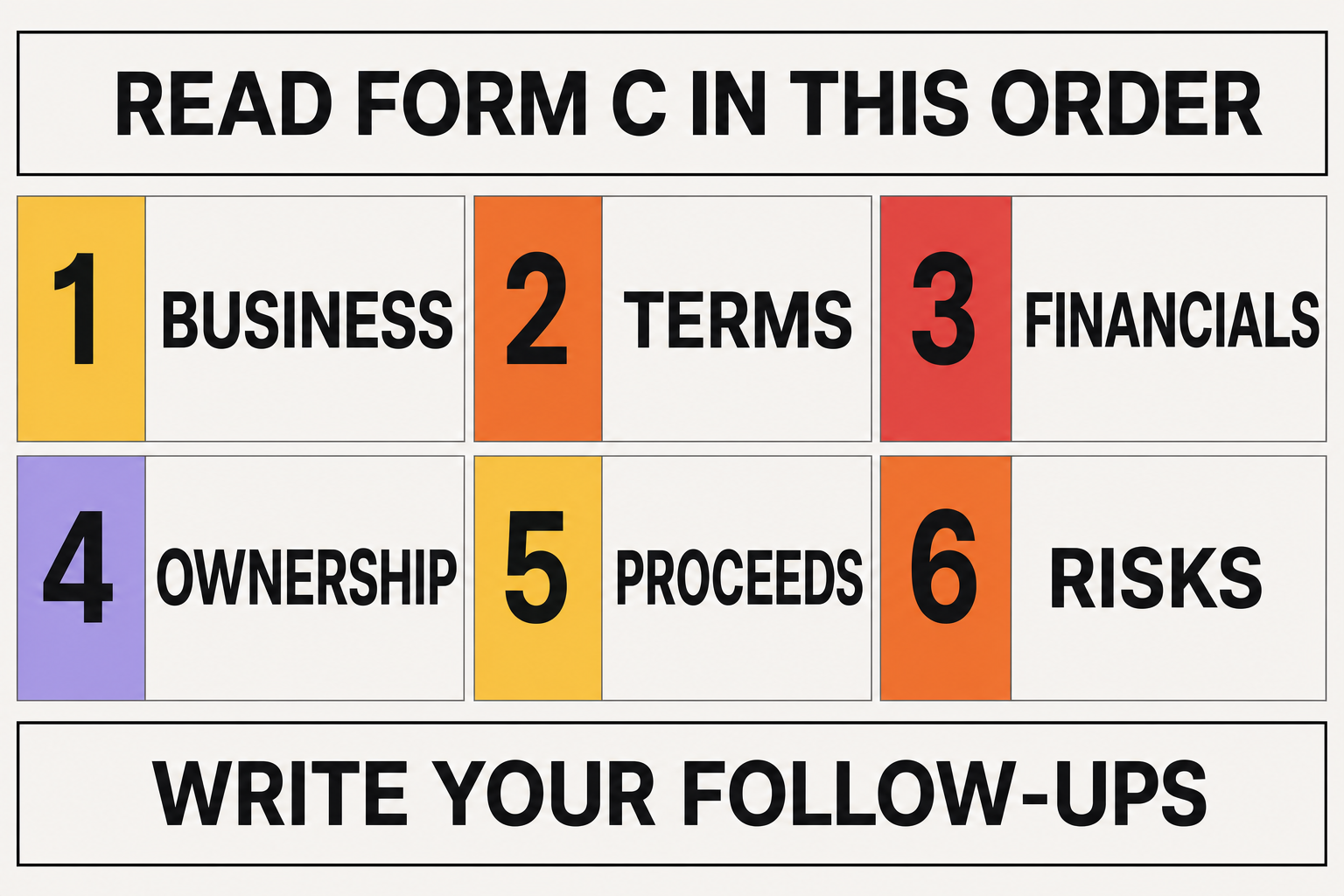
Form C contains a lot of information, but a fixed sequence keeps you from getting lost in the campaign story. Read the security instrument before deciding what the company might become. Reconcile the numbers before debating the upside.
1. Business, people, and evidence
Form C identifies the legal entity, its jurisdiction and formation date, officers and directors, their recent business experience, and beneficial owners with at least 20% of voting power. It also describes the business, anticipated business plan, current employees, and material risks.
Translate that disclosure into testable claims:
- Product: What exists today? Separate a released product from a prototype, pilot, or roadmap.
- Customers: Reconcile claimed users, signed contracts, revenue, receivables, cash collections, churn, and concentration. A letter of intent is not revenue.
- Market: Compare the broad market claim with the segment this team can reach using its current product, sales motion, licenses, and capital.
- Team: Check role dates, full-time status, turnover, key-person dependence, and whether the experience described is relevant to the work ahead.
- Entity: Confirm that the issuer selling the security owns or controls the intellectual property, contracts, licenses, brand, and revenue described in the pitch.
The required three-year work history is not a background check, and the 20% owner list is not a complete capitalization table. Treat both as starting points.
2. The security and offering terms
The Form C cover shows the security type, price or pricing method, target amount, maximum amount, deadline, oversubscription policy, allocation method, intermediary, and intermediary compensation. The body and exhibits should explain the security's rights and how the transaction closes.
Read the actual instrument clause by clause. A label such as “common stock,” “preferred stock,” “note,” or “Simple Agreement for Future Equity (SAFE)” does not tell you enough. Write down:
- what you receive for your check;
- voting, information, distribution, conversion, redemption, and transfer rights;
- liquidation priority and claims that rank ahead of you;
- maturity, interest, collateral, defaults, or conversion triggers for debt;
- the valuation cap, discount, capitalization definition, and liquidity treatment for a SAFE;
- who can amend the terms or authorize senior securities; and
- how the target, maximum, deadline, early closing, cancellation, and oversubscription rules work.
An investor ordinarily may cancel a commitment for any reason until 48 hours before the disclosed offering deadline. That is a cutoff before the deadline, not a right to cancel within 48 hours after investing. A material amendment creates a different reconfirmation process, covered below.
Form C is only one part of an angel investing due diligence checklist. Verify the people, market, customers, legal entity, and key documents outside the filing when the size and risk of your check justify it.
3. Financial statements and financial condition
Form C generally includes U.S. generally accepted accounting principles (GAAP) financial statements for the two most recently completed fiscal years, or the period since inception if the issuer is younger. The package includes balance sheets, comprehensive income, cash flows, changes in stockholders' equity, and notes. The required level of accountant involvement depends on the offering amount and issuer history.
Read the notes and accountant's report before reaching for ratios. Then check:
- Cash: Does opening cash plus operating, investing, and financing cash flow reconcile to ending cash?
- Revenue quality: How much revenue was collected, recurring, concentrated, related-party, or noncash?
- Gross margin: Does the relationship between revenue and direct cost make sense, and why did it change?
- Burn: What is normalized monthly cash use after separating one-time items, capital spending, debt service, and delayed payables?
- Debt and senior claims: Do loans, accrued interest, leases, tax obligations, SAFEs, and notes reconcile across the statements, Form C, and security documents?
- Subsequent events: What changed after the balance-sheet date? Ask about new financings, customer losses, defaults, litigation, grants, and material contracts.
A review is not an audit. An audit adds scrutiny, but neither process establishes fair value, validates forecasts, guarantees solvency, or eliminates fraud risk.
4. Ownership, valuation, and dilution
Form C asks for outstanding security classes, material terms, options and warrants, conversion rights, valuation methods, and ways other classes or future corporate actions may dilute or limit the offered security. Rebuild the math rather than accepting one headline valuation.
Suppose a company has 800,000 fully diluted shares before the offering and sells new common shares for $10 each. The implied pre-money equity value is $8 million. If the company raises its $1 million maximum, it issues 100,000 new shares and has 900,000 fully diluted shares immediately after the close. The new crowd owns 11.11%, and a $10,000 investor owns 1,000 shares, or about 0.1111%.
At a $250,000 target, the same investor would initially own about 0.1212% because only 25,000 new shares were issued. That larger percentage does not automatically make the target close better: the company also receives much less cash and may need another financing sooner.
This simple example does not apply to every security. SAFEs, notes, multiple preferred classes, option-pool increases, warrants, and side letters can change the denominator and economic rights. Build issued, fully diluted, target-close, maximum-close, and plausible next-round versions of the cap table. Our guide to how dilution changes your stake explains the mechanics in more depth.
Our co-founder and general partner Shiyan Koh puts the reason plainly: “Show me the incentives, and I'll show you the outcome.” Apply that lens to founder ownership, executive compensation, intermediary fees, insider loans, related-party payments, voting control, and who benefits from future financings or a sale.
5. Use of proceeds and runway
Form C requires a reasonably detailed use of proceeds at the target and maximum, including offering expenses and net proceeds. Convert those categories into a cash calendar and a milestone budget.
Assume a $1 million maximum, a 7% cash intermediary fee, $30,000 of other cash offering costs, and normalized cash use of $120,000 per month. Estimated net proceeds are $900,000, which equals 7.5 months of runway before considering opening cash, revenue, capital spending, debt payments, taxes, or management changes.
At a $250,000 target with the same fee rate and fixed costs, estimated net proceeds are $202,500. That is about 1.69 months at the same burn.
These are scenarios, not forecasts. The point is to ask whether the target amount funds a coherent, value-creating milestone. If the plan only works at the maximum, a legal target close can still leave the company facing near-term refinancing and dilution.
Look for:
- vague categories such as “growth” or “working capital” without amounts, timing, or outputs;
- proceeds that repay insiders, affiliates, overdue bills, or senior lenders;
- offering costs that do not reconcile across the cover and proceeds schedule;
- hiring or revenue assumptions that are necessary for survival but unsupported; and
- no plan for the period between the target-funded milestone and the next financing.
6. Risk factors, conflicts, and what is missing
Form C requires material factors that make the investment speculative or risky. The instructions call for issuer- and offering-specific disclosure rather than generic boilerplate.
Turn each material risk into a causal chain: what could happen, what would warn you, how the event affects cash or the security, what management can do, and what exposure remains. Check product and cybersecurity risk, customer concentration, regulation, intellectual property, key people, liquidity, debt, supply dependencies, dilution, seniority, and the possibility of total loss.
Read related-party transactions and conflicts with equal care. The regulatory disclosure threshold is not your personal materiality threshold. A smaller founder loan, affiliate lease, service agreement, guarantee, or intellectual-property license can still explain cash use or incentives.
The filing's eligibility and “bad actor” disqualification questions are also narrower than a general clean-record certificate. They cover defined people, events, dates, and lookback periods. They do not replace proportionate checks for litigation, insolvency, liens, licensing problems, tax disputes, employment claims, or intellectual-property conflicts.
Finally, compare the risks with the rest of the filing. A company that says customer concentration is immaterial while one customer drives most receivables needs an explanation. A short risk section is not proof of a low-risk company. Your personal ability to absorb loss and illiquidity still matters; that is a separate question about your investment risk tolerance.
How much financial scrutiny does Form C require?
The current inflation-adjusted thresholds took effect on September 20, 2022 and remained in the SEC's current Form C as of July 31, 2026. Old SEC pages and third-party guides may still show the superseded $107,000, $535,000, and $1.07 million figures.
- $124,000 or less: The issuer provides financial statements plus specified federal tax-return line items, if any, certified by its principal executive officer. If independently reviewed or audited statements are already available, the issuer must use them instead.
- More than $124,000 through $618,000: An independent public accountant reviews the statements. If audited statements are already available, the issuer must use them instead.
- More than $618,000 through $1,235,000 for a first-time Reg CF issuer group: An independent review is sufficient if audited statements are not already available.
- More than $618,000 for an issuer group that has previously sold Reg CF securities: An independent audit is required.
- More than $1,235,000 for a first-time Reg CF issuer group: An independent audit is required.
Boundary points matter. Exactly $124,000 sits in the officer-certified tier. Exactly $618,000 sits in the reviewed tier. A first-time issuer at exactly $1,235,000 may still use reviewed statements if audited statements are unavailable; $1,235,001 requires an audit.
The calculation is not simply the target or your check. The current Form C instructions define the aggregate amount using Regulation Crowdfunding sales during the preceding 12 months by the issuer, its predecessors, and entities it controls or shares common control with, plus the current maximum offering amount. A prior Reg CF sale, not merely a prior Form C filing, affects the first-time issuer exception.
These tiers tell you the minimum disclosure process, not the quality of the business. Read the report language, statement dates, notes, and reconciliations. If a required review report is modified, or a required audit has a qualified or adverse opinion or disclaimer, the current instructions say it does not satisfy the requirement.
Follow amendments and reports after the first Form C
The original filing can become stale during the offering, and federal annual reporting can end while you still own the security.
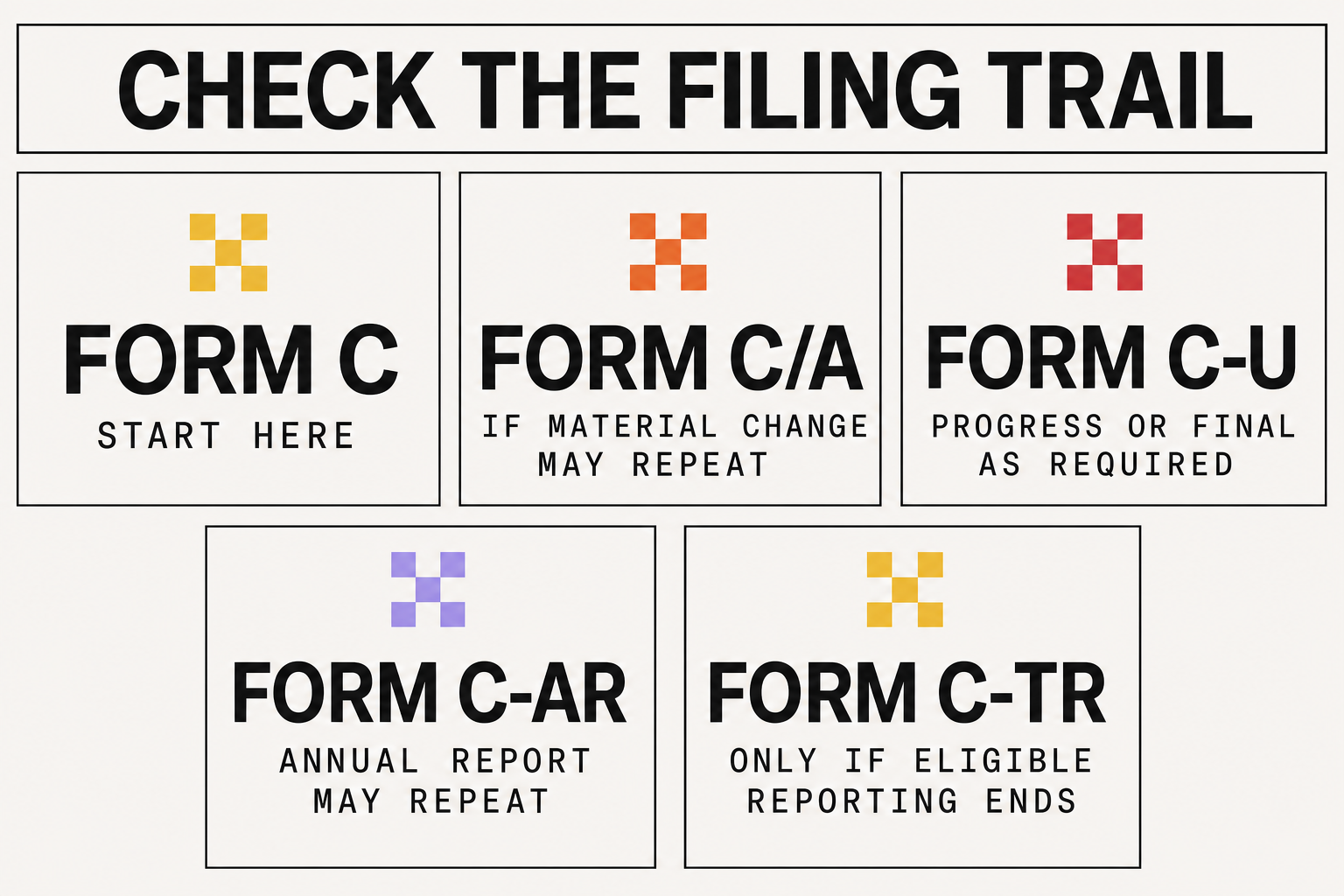
Form C/A: amendments
An issuer must amend an open offering for a material change, addition, or update. If the amendment is material, committed investors receive notice and have five business days from receipt to affirmatively reconfirm. Silence cancels the commitment. That five-day period is the investor's response window, not a general five-day filing deadline for the issuer.
Check whether an amendment changed the price, security instrument, valuation cap, target, maximum, deadline, use of proceeds, financials, management, risks, or closing mechanics. Re-run your analysis with the current terms.
Form C-U: progress and final sales
An issuer generally files a C-U within five business days after reaching 50% and 100% of the target. If the intermediary posts frequent public progress updates, the issuer may skip those separate threshold filings. A final C-U reporting total securities sold is still required when the offering takes proceeds above the target, and the platform-update alternative also requires a final total.
Do not treat a missing 50% or 100% C-U as proof of noncompliance before checking the live platform and final filing.
Form C-AR: annual reports
An issuer that sold Reg CF securities generally files Form C-AR in EDGAR and posts it on its website within 120 days after fiscal year-end. The report updates much of the company, management, ownership, risk, capitalization, debt, related-party, financial-condition, and financial-statement information.
The annual statements do not automatically require an independent review or audit. If reviewed or audited statements are available, the issuer generally uses them instead of officer-certified statements.
Form C-TR and C-W: the trail can stop
Form C-TR says the issuer is terminating its Reg CF annual-reporting duty after meeting one of the rule's conditions. Those conditions include becoming an Exchange Act reporter, meeting holder-and-reporting tests, repurchasing or repaying all Reg CF securities, or liquidating or dissolving. A C-TR is not proof of success, failure, an exit, or liquidity.
Form C-W withdraws an offering statement. If an expected annual report is missing, check the issuer's fiscal year-end, full filing history, and any C-TR before drawing a conclusion.
Reporting may legally stop long before your investment becomes liquid. Unless the security contract grants stronger information rights, model the position as potentially long-lived and information-poor.
Turn the filing into questions, not a verdict
Our co-founder and general partner Elizabeth Yin writes, “The more disciplined you are in your thought process/rubric, the more you can improve over time.” A repeatable Form C process makes your assumptions visible, whether you invest or pass.
Ask questions that can be answered with a number, date, definition, or document:
- Which Form C/A and version of the security instrument are current?
- Can the issuer provide a dated, fully diluted cap table that reconciles every class, option, warrant, SAFE, note, and prior offering?
- What does a $10,000 investment receive at the target and maximum under the actual instrument?
- Which operating milestone can the target fund after fees, and how much additional capital is expected before breakeven?
- What changed between the latest balance-sheet date, the Form C filing date, and today?
- How much reported revenue has been collected in cash, is recurring, and comes from the largest customers?
- Which proceeds pay insiders, affiliates, creditors, or entities other than the issuer?
- What securities, pool increases, conversions, or debt can dilute or rank ahead of this security?
- What reports will investors receive if Reg CF annual reporting terminates?
The public platform channel is often the right place to ask. Keep the questions neutral and specific, then reconcile each answer with the filing. Our guide to questions to ask startup founders can help you probe the business beyond the form.
Record your conclusion while the evidence is fresh. A simple way to write an investment memo is to state what you own, the valuation and dilution math, how the company uses your capital, what must go right, the main failure modes, and which questions remain unanswered.
A final Form C review checklist
Before committing, confirm that you can:
- identify the legal issuer, intermediary, current filing, and every relevant exhibit;
- state the security and its rights in plain English;
- explain the price, target, maximum, deadline, allocation, cancellation, and closing mechanics;
- reconcile the capitalization across the Form C, financials, and security documents;
- calculate ownership at the target and maximum and model a plausible next round;
- bridge gross proceeds to net cash, runway, and a target-funded milestone;
- identify debt, senior claims, related parties, insider payments, and intermediary incentives;
- connect the tailored risk factors with the financial statements and business evidence; and
- list unresolved questions and explain why each one is acceptable or a reason to pause.
Pause rather than guess when the current instrument is missing, the cap table omits known convertibles, the financial statements or notes are incomplete, the target does not fund the stated plan, related-party payments are vague, a material amendment is pending, or decision-critical math will not reconcile.
Form C is a map of the offering, not a verdict on it. If you want to put this review framework into practice with other investors, Angel Squad is our angel-investing community for investor education, peer learning, and optional deal-by-deal opportunities. Every deal is optional, and the same discipline should apply whether the answer is invest, pass, or ask one more question.
Apply to Angel Squad to keep learning alongside investors who take the work seriously.






.png)




.png)