
How to invest in pre-IPO companies: a practical guide
A famous private company can look like an obvious investment. The hard part is figuring out whether real shares are available, whether you qualify to buy them, what rights come with them, and whether the transaction can actually close.
This guide covers that access workflow for U.S. investors. If you need a broader foundation first, start with our guide to angel-investing basics.
First, confirm which pre-IPO routes you can use
Pre-IPO investing means buying a security connected to a private company before that company completes a registered initial public offering (IPO). It is not the same as requesting shares in an IPO through a public brokerage account. It also does not mean the company has filed to go public or ever will.
Pre-IPO investing can be legal, but the offer and any later resale must be registered or fit an exemption, and the investor must meet that route's conditions.
Your first decision is eligibility, not the company name.
Many private rounds and secondary transactions rely on exemptions that limit who can invest. Under the current SEC criteria, an individual can qualify as an accredited investor in several ways, including:
- Net worth above $1 million, excluding the value of your primary residence, alone or with a spouse or spousal equivalent.
- Income above $200,000 individually, or joint income above $300,000 with a spouse or spousal equivalent, in each of the prior two years, with a reasonable expectation of reaching the same level in the current year.
- Certain professional credentials held in good standing, currently Series 7, Series 65, or Series 82.
The offering route changes the test. Rule 506(b) can include a limited number of financially sophisticated non-accredited investors, but the issuer decides whom to invite. It is not a general retail-access route. Rule 506(c) allows broad solicitation, but every purchaser must be accredited and the issuer must take reasonable verification steps. A checkbox alone is not enough.
Non-accredited investors are not locked out of every private-company offering. A specific company may raise through Regulation Crowdfunding (Reg CF) using a registered broker-dealer or funding portal. Reg CF applies annual investment limits to non-accredited investors, requires a Form C filing, and generally restricts resale for one year. Some companies use Regulation A, which has an offering statement; Tier 2 adds audited financial statements and ongoing reports, and limits some non-accredited buyers unless the securities will be listed on a national exchange.
Those routes can provide private-company exposure. They do not create a workaround for buying any late-stage company you want.
Choose the asset before you choose the platform
This guide covers four practical routes:
- Buy a new security in a primary financing round.
- Buy an existing shareholder's security in a direct secondary transaction.
- Buy an interest in a special purpose vehicle (SPV) or single-company fund.
- Buy through an issuer-specific Reg CF or Reg A offering.
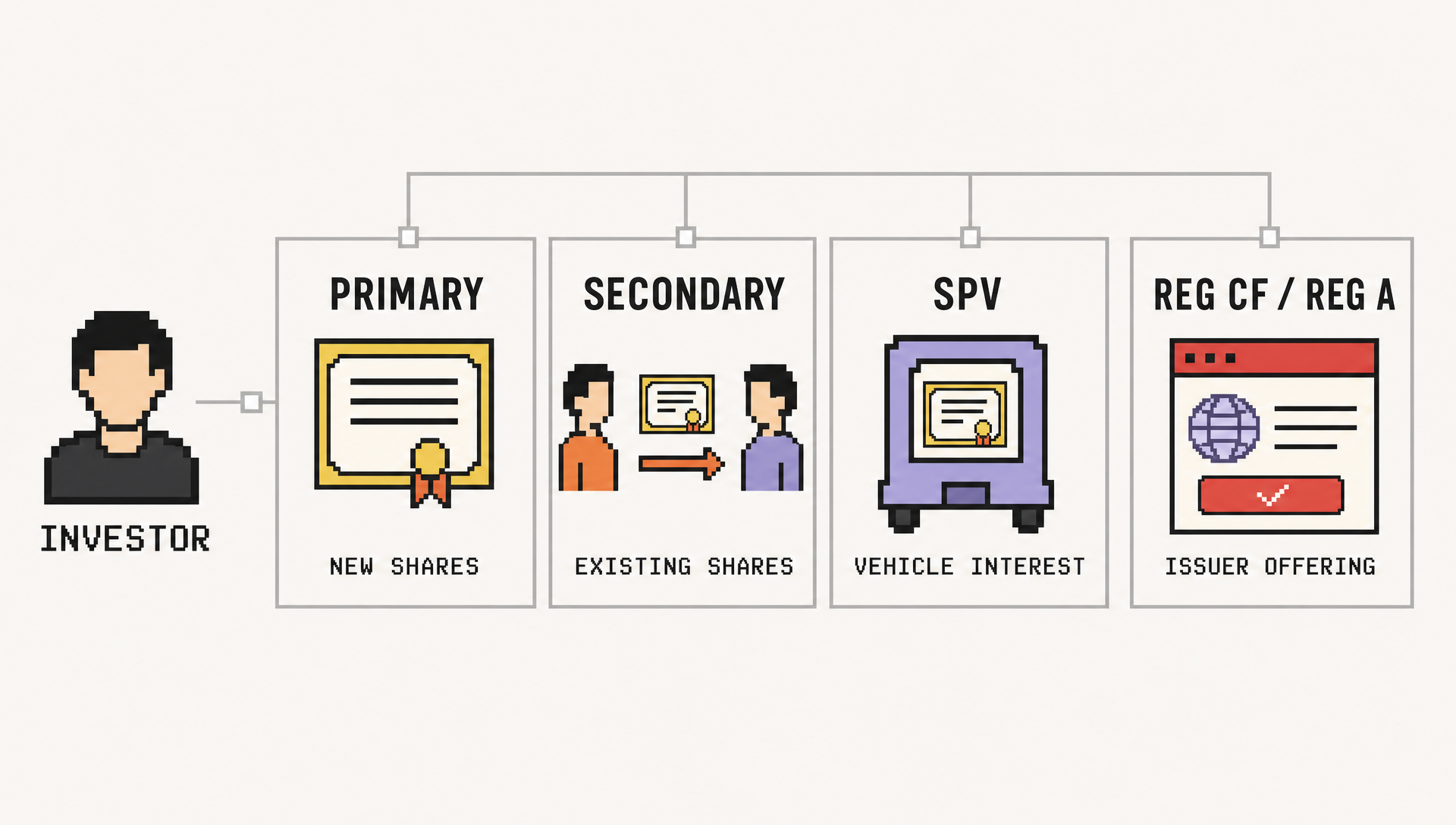
Each can put the same company name on a dashboard while giving you a different legal asset.
Primary financing round
In a primary round, the company issues a new security and the investment proceeds generally go to the company. Venture rounds often issue preferred stock with negotiated economic and governance rights.
The price per share is only one term. The current venture financing documents published by the National Venture Capital Association include a certificate of incorporation, stock purchase agreement, investors' rights agreement, voting agreement, and right of first refusal and co-sale agreement. Together, those documents can define liquidation preferences, conversion, dividends, voting, information rights, pro rata rights, and transfer limits.
This route is best suited to an investor eligible for the specific offering who has access to a live round and enough time and expertise to review the full document set. Eligibility does not guarantee an allocation.
Direct secondary purchase
In a direct secondary, you buy an existing security from an employee, founder, or early investor. The cash generally goes to the seller, not the company.
Confirm the class before comparing the price with the latest fundraising round. An employee may be selling common stock while the round created preferred shares with stronger downside rights. The two prices are not automatically comparable.
A marketplace match also is not a completed trade. Private securities may be restricted, and the resale still needs a valid legal path. The company may require consent, a legal opinion, or a transfer fee. A right of first refusal (ROFR) may let the company or another entitled holder buy the shares on the same terms instead of you. The SEC's private secondary overview is a useful starting point, but the executed company documents and transaction facts control.
This route is best suited to an accredited buyer seeking a specific private company who can accept pricing uncertainty, a conditional close, and an indefinite hold.
SPV or single-company fund
An SPV pools investors into one legal vehicle for a specific deal. You normally own an interest in the vehicle; the vehicle owns, or is supposed to acquire, the underlying company security. That is different from appearing directly on the company's capitalization table.
Trace the ownership chain all the way through:
- Which legal entity are you investing in?
- What exact company security will that entity own?
- Does the vehicle already hold the shares, have a signed purchase agreement, or only expect to gain access?
- Who controls votes, information requests, follow-on decisions, and distributions?
- Can you transfer your vehicle interest?
Then read the full fee stack. Setup, administration, state filings, management fees, transaction costs, and carried interest are separate categories. In one AngelList SPV example, a $200,000 raise paid $8,000 in administrative costs and $1,200 in state fees, leaving $190,800 for the company. That is an illustration, not a market-wide quote.
If this structure is new to you, our SPV process guide goes deeper into administration and distributions.
This route is best suited to an investor eligible for the vehicle who wants one-deal exposure with delegated administration and accepts vehicle-level fees, governance, and reporting.
Regulation Crowdfunding or Regulation A
Reg CF and Reg A can give non-accredited investors access to securities from specific private issuers. Read the actual filing rather than relying on the campaign page.
For Reg CF, review the Form C and any amendments on the SEC's Electronic Data Gathering, Analysis, and Retrieval (EDGAR) system. The filing covers the security, price, use of proceeds, owners and management, related-party transactions, financial condition, and financial statements. The required statements and whether they must be certified, reviewed, or audited depend on the offering amount and whether the issuer has previously sold securities under Reg CF.
Reg A uses an offering statement, and Tier 2 issuers provide audited financial statements and ongoing reports. That additional disclosure can help, but it does not remove company, valuation, or liquidity risk.
These routes are best suited to an investor who does not qualify for a conventional private placement and finds an issuer-specific opportunity that survives diligence. They will not necessarily include the mature private company already on your wish list.
How to buy pre-IPO shares step by step
1. Set an illiquid-risk budget
Assume the position could go to zero or remain private longer than your plan allows. If a total loss would damage your finances, or an indefinite hold would leave you needing liquidity, the investment does not fit.
Count exposure you already have through employer stock, private funds, venture funds, and companies in the same sector. Several private investments can still be one concentrated bet if they depend on the same market, funding environment, or exit window. FINRA's concentration guidance notes that private placements may be hard to sell quickly or efficiently.
There is no universal percentage that makes pre-IPO investing prudent. Your liquidity, obligations, other assets, time horizon, and ability to absorb a total loss matter. Our portfolio-fit guide can help you frame that decision before you evaluate a deal.
2. Write down the exact asset and ownership chain
Do not wire money until you can state the investment in one sentence:
I am paying $___ for ___ shares or units of ___ class, issued by ___ or held through ___, with the rights and fees in these executed documents.
Record the issuer, seller, security class, share or unit count, fully diluted share count, price, vehicle, intermediary, custodian, transfer agent, and expected closing date. For an SPV, draw the path from your vehicle interest to the underlying shares.
Also ask whether the displayed amount is your commitment, your funded amount, or the amount invested after expenses. Those numbers can differ.
3. Verify the seller, intermediary, and offering
Verification has three layers.
Check the people and firms. Search every broker or brokerage firm involved in FINRA BrokerCheck and review registration status, employment history, customer disputes, and disciplinary disclosures. If an investment adviser is involved, search the SEC's Investment Adviser Public Disclosure database.
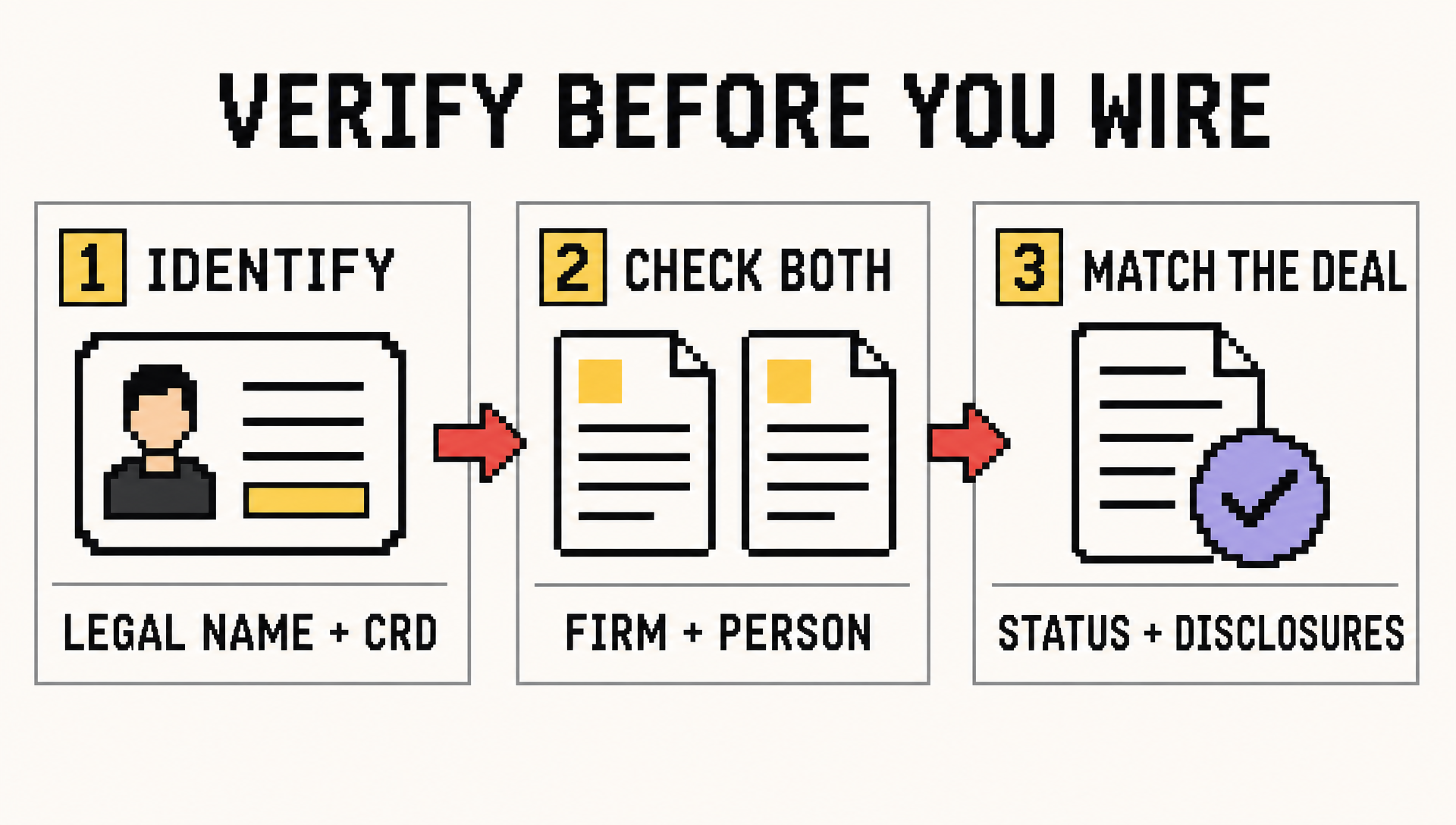
Check the offering. Search EDGAR for a Form D, Form C, Regulation A offering statement, or public-company filing when applicable. A Form D is a notice, not SEC approval, and it contains only limited information.
Check the asset. Confirm that the seller owns the exact shares or that the vehicle has possession, a binding acquisition agreement, or documented access. FINRA's 2026 oversight report describes pre-IPO funds where firms failed to confirm possession of or access to the advertised shares and failed to understand acquisition costs.
Follow the cash too. Know which account, escrow agent, custodian, or vehicle receives your money, whether that arrangement is regulated, and when the funds can be released.
4. Price the exact security
A company's headline valuation is not your purchase price. For a direct share purchase, multiply the per-share price by the fully diluted share count to estimate the company's implied equity value. Then compare the security's rights and all-in transaction costs.
Compare:
- The most recent preferred-round price and date.
- The class and rights sold in that round.
- The 409A common-stock valuation, if available.
- Recent completed secondary transactions.
- Current bids and asks, with their dates and sizes.
- The fully diluted share count and planned new issuance.
- Liquidation preferences, conversion, dividends, and seniority.
- Every fee, markup, spread, and vehicle expense.
A 409A appraisal is generally used to estimate the fair market value of common stock when pricing employee stock options. It is not automatically the fair price for preferred stock, an employee's common shares, or an SPV unit. A marketplace indication is not necessarily executable either.
Our co-founder and general partner Elizabeth Yin puts it plainly:
“Angel investing or VC is a comparison game.”
Compare several opportunities and the option to do nothing. A company can look wonderful in isolation and still offer a weak security at a bad price.
5. Diligence the company and terms
FINRA's private-placement guidance gives broker-dealers a useful minimum frame: investigate the issuer and management, business prospects, assets, claims, and intended use of proceeds. An individual investor can use the same headings, then go deeper.
Ask for enough current information to test:
- Revenue quality, growth, gross margin, burn, runway, and financing needs.
- Customer concentration, retention, sales efficiency, and competitive position.
- Management background, incentives, litigation, and regulatory exposure.
- Capitalization table, debt, options, convertibles, warrants, and planned dilution.
- Security rights, preference stack, voting, information, and transfer terms.
- Use of proceeds, related-party transactions, placement compensation, and conflicts.
- Plausible exits, including acquisition, tender, continued private ownership, down round, IPO, and failure.
A private placement memorandum may not be required and, when provided, is not reviewed by a regulator. Missing, stale, or inconsistent information is part of the risk. Do not fill a gap with the seller's optimism.
Inside Angel Squad, our angel-investing community, members learn from deal memos, investing education, and peer discussion before choosing whether to participate in an available opportunity. Accreditation is not required to join, but it is required to invest in relevant offerings, and every deal is optional.
6. Map approvals, fees, and failure points
Before funding, map every event between agreement and ownership for your route. For a direct secondary, the path may include:
- Buyer and seller agree on the security, quantity, and price.
- The intermediary verifies identities, eligibility, and seller ownership.
- The parties execute the purchase documents.
- The company reviews the transfer and may exercise or waive its ROFR.
- Any required consent, legal opinion, transfer-agent step, or fee is completed.
- Funds are released under the closing terms.
- The company's records or the transfer agent's records show the new owner.
A primary round, SPV, Reg CF, or Reg A offering follows a different subscription and closing path; use its offering documents to identify the equivalent approvals, funding conditions, and ownership record.
Read what happens if the company blocks the transfer, another party exercises the ROFR, the vehicle fails to acquire the shares, the closing deadline passes, or the deal size changes. Confirm when your commitment becomes binding and when a refund is available.
Then calculate all-in cost in dollars, not labels. Include commissions, markups, spreads, legal costs, transfer fees, setup and administration, state fees, management fees, carry, custody, and tax-document charges. Ask what portion of your cash reaches the underlying investment and what will be deducted before a future distribution.
7. Close, confirm, and save the records
After close, obtain proof of what you own. For direct shares, that may include an updated capitalization-table record, transfer-agent statement, or certificate. For a vehicle, keep the executed subscription agreement, limited liability company or partnership agreement, ownership statement, and final closing notice.
Save the offering and transaction documents, wire confirmation, fee breakdown, acquisition date, lot, price, share or unit count, tax identification, issuer notices, and later distributions. The IRS generally starts stock basis with the purchase price plus costs such as commissions and transfer fees, according to Publication 550. The exact treatment depends on the asset and structure, so use a qualified tax professional rather than assuming a stock purchase and an SPV interest report the same way.
8. Monitor without assuming an IPO
Private-company reporting can be irregular. Decide before closing what updates you are entitled to receive, who will send them, and what you will track.
Model several outcomes instead of one IPO date:
- The company remains private and raises more capital.
- A tender or secondary opportunity creates partial liquidity.
- The company is acquired.
- A down round changes valuation and the preference stack.
- The company completes an IPO.
- The company fails.
Even an IPO does not guarantee an immediate or profitable exit. Restricted-share rules, contractual lock-ups, conversion mechanics, and post-IPO price movement can all affect when and how much you can sell. The SEC warns that a private company may never go public and that a resale market may never develop in its pre-IPO scam alert.
Walk away when key questions stay unanswered
Decline the deal when:
- The seller or vehicle cannot prove ownership of or access to the exact security.
- The professional or firm cannot explain its registration and role.
- The pitch relies on pressure, artificial scarcity, guaranteed allocation, guaranteed returns, or an “imminent” IPO.
- The price comparison ignores share class, fully diluted count, preferences, dilution, or fees.
- Financials are missing, stale, internally inconsistent, or unsupported by primary documents.
- The issuer or vehicle cannot explain ownership, reporting, transfer restrictions, conflicts, use of proceeds, or what happens if the transaction fails.
- The capital is needed on a timetable or adds more concentration than your portfolio can absorb.
FOMO is not diligence. As our co-founder Elizabeth Yin puts it:
“You accept that you will miss some.”
A disciplined no is better than inventing answers that the evidence does not support.
The best pre-IPO process is repeatable
Use the same order every time: confirm eligibility, name the exact asset, trace ownership, compare price and rights, verify the company and counterparties, map fees and approvals, and test the position against your portfolio.
If you want to learn with other investors, review deal memos, and choose from optional opportunities, apply to Angel Squad. You do not need to be accredited to join the community; you do need to be accredited to invest in relevant offerings, and no deal is mandatory.
Pre-IPO securities are speculative, illiquid, and capable of total loss. This guide is educational and is not investment, legal, or tax advice. Have qualified securities counsel, a tax professional, and an adviser who understands your circumstances review any material commitment.






.png)




.png)