
How to Invest in Private Companies Without Flying Blind
Buying a public stock takes a brokerage account and a ticker symbol. Buying into a private company means choosing an access route, qualifying for the offering, reading bespoke terms, and accepting that your money may be locked up for years.
The route matters as much as the company. It determines what you own, what information you receive, what you pay, and your path to liquidity.
Start With the Exposure You Actually Want
“Private company” can describe a two-person startup, a late-stage company preparing for an initial public offering (IPO), or a profitable family business that never plans to list.
Answer three questions before looking at deals:
- Do you want one company or a portfolio? A direct investment gives you concentrated exposure. A venture or private equity fund spreads manager-selected capital across several companies.
- Which stage fits your edge? Early-stage investing rewards insight into founders, customers, and emerging markets. Late-stage investing depends more on price, share class, growth durability, and the actual path to liquidity.
- How involved do you want to be? Direct angels may source, assess, and support companies themselves. Fund investors delegate those jobs to a manager and pay for it.
Earlier access does not make an investment cheaper or better. A private round can carry an aggressive valuation, weak rights, or a preference stack that leaves common shareholders with little. The security and price deserve the same attention as the company name.
Can Anyone Invest in a Private Company?
Yes, but no single route is open to everyone.
Many direct startup rounds, special purpose vehicles (SPVs), private funds, and secondary transactions rely on exemptions that restrict who can invest. The most common U.S. qualification is accredited investor status. An individual generally qualifies through income above $200,000, income above $300,000 with a spouse or spousal equivalent, net worth above $1 million excluding a primary residence, or certain securities licenses. The income test covers each of the prior two years plus a reasonable expectation for the current year. The SEC lists the full accredited investor criteria.
Non-accredited investors still have routes. Regulation Crowdfunding (Reg CF) and some Regulation A offerings can accept them, subject to offering-specific rules and investment limits. Certain registered funds also offer indirect private-market exposure to retail investors.
Accreditation is an eligibility threshold, not a certificate of investing skill. It does not make an offering safer.
This is general education, not legal or tax advice. Have qualified independent legal and tax professionals review the specific offering and your circumstances.
Five Ways to Invest in Private Companies
The five routes below cover equity and equity-linked exposure, including shares, SAFEs, convertible notes, and interests in vehicles that hold those securities. Private credit sits outside this framework. It creates a lender relationship and calls for different underwriting of repayment capacity, collateral, covenants, seniority, and recovery after default.
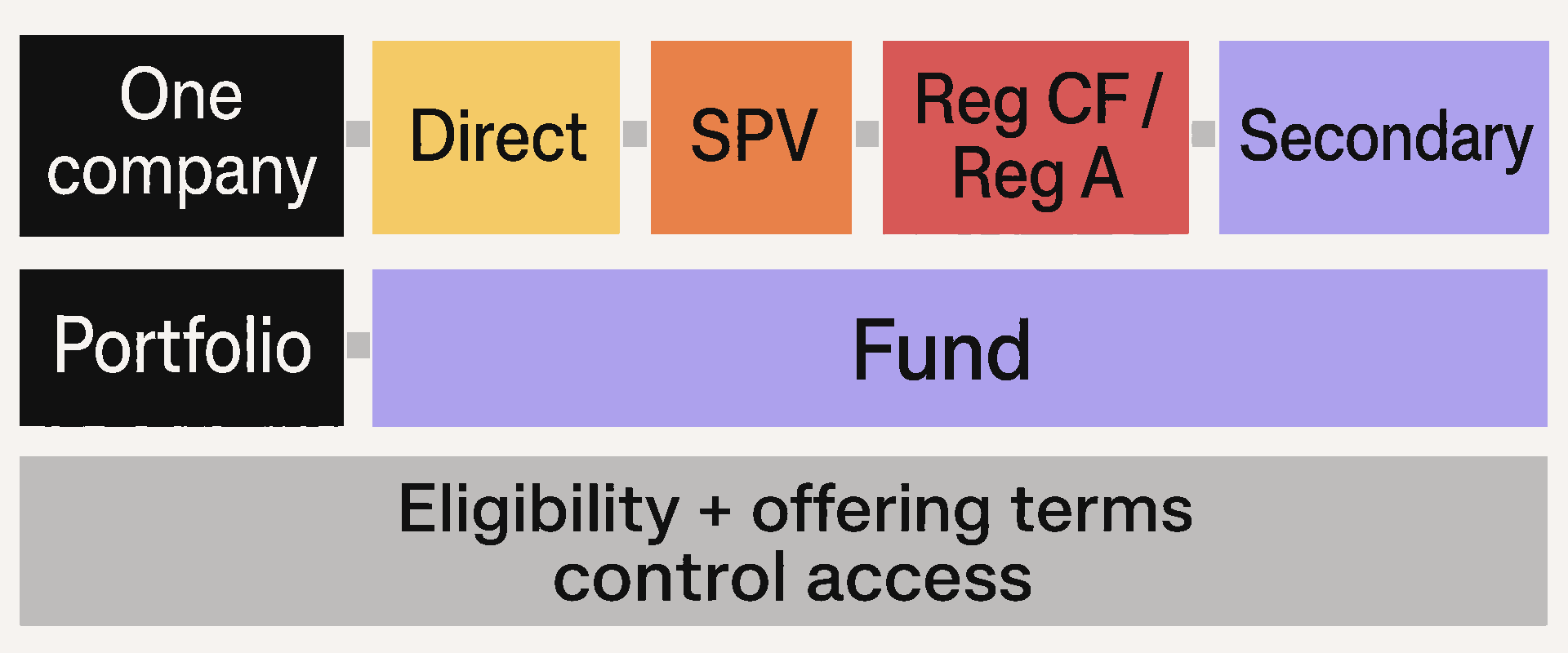
For equity and equity-linked investments, the five main routes are:
- A direct primary investment, for operators with company access and the time to do their own work.
- An angel syndicate or SPV, for accredited investors who want deal-by-deal startup exposure with a lead.
- A Regulation Crowdfunding or Regulation A offering, for non-accredited and accredited investors who want self-directed, deal-by-deal exposure.
- A secondary transaction, for eligible investors seeking shares in a later-stage private company.
- A private or registered fund, for investors who prefer a manager and pooled exposure.
1. Invest Directly in a Company’s Financing Round
In a primary investment, your money goes to the company. In return, you receive a security such as preferred stock, common stock, a Simple Agreement for Future Equity (SAFE), a convertible note, or an ownership interest in a limited liability company.
Direct access usually comes through founders, professional networks, or angel groups. A closely held business may negotiate dividends or governance, while a venture-backed startup usually offers standardized round terms with little control for a small angel.
Best suited to: well-connected founders, sector specialists, and operators who can assess the business and add relevant help after investing.
Main tradeoff: you control your selection, but sourcing, diligence, negotiation, paperwork, and monitoring sit with you. A small check may also receive no information or pro rata rights unless the documents grant them.
2. Join an Angel Syndicate or Deal-Specific SPV
A syndicate pools investors into an SPV created for one company. You buy an interest in the SPV, and the SPV holds the company security. A lead sources the deal, negotiates access, presents an investment memo, and often manages the company relationship.
Read the vehicle terms alongside the company terms. Administrative fees, management fees, and carried interest can reduce your net return. The lead or manager may control votes, information flow, follow-on decisions, and the timing of distributions.
Our Angel Squad angel-investing community uses this route to pair education and peer learning with early-stage opportunities sourced by our Hustle Fund venture team. Members choose whether to participate in each deal through AngelList, with minimums typically starting at $1,000. Joining the community does not require accreditation, while investing in its offerings does.
Best suited to: busy operators who want curated deal flow and lower deal-by-deal minimums while retaining the choice to pass.
Main tradeoff: the SPV makes access and administration easier, but you own a vehicle interest rather than shares registered directly in your name. Our guide to syndicate and SPV mechanics goes deeper on that distinction.
3. Use Regulation Crowdfunding or Regulation A
Reg CF lets eligible U.S. companies raise up to $5 million in 12 months through one SEC-registered broker-dealer or funding portal. Both accredited and non-accredited investors can participate. Non-accredited investors have annual limits based on income and net worth.
The company files a Form C with information about its business, owners, use of proceeds, offering terms, related-party transactions, financial condition, and financial statements. That disclosure gives you a starting point. It is not an SEC endorsement.
Find the issuer’s latest Form C and amendments in EDGAR, then reconcile the security, price, financials, use of proceeds, and offering status with the deal page. Identify the intermediary’s legal entity too. A funding portal should appear on FINRA’s current registered portal list; a broker-dealer and its salesperson should appear in FINRA BrokerCheck. Match the legal name and website, including any suspension shown in the record. Registration confirms identity and regulatory status. It does not establish that the investment is sound.
Reg CF securities generally cannot be resold for one year, and a market may never develop after that restriction ends. The SEC’s crowdfunding rules also require online transactions to run through the registered intermediary.
Regulation A is an exemption from registration for public offerings. An eligible issuer files Form 1-A and may begin sales only after the SEC qualifies the offering statement. The offering may be open to non-accredited investors. Tier 2 generally limits their purchases unless the securities will list on a national exchange upon qualification. Read the qualified offering circular, amendments, and any ongoing reports on EDGAR. SEC qualification permits the offering to proceed; it does not approve the merits. Disclosure, limits, reporting, and liquidity differ by tier and offering under the SEC’s Regulation A rules.
Best suited to: self-directed investors who need broader eligibility or want deal-by-deal access without needing near-term liquidity.
Main tradeoff: access is broader, yet each investor still carries the company, security, dilution, and liquidity risk. A low minimum changes the size of the possible loss, not the probability of it.
4. Buy Existing Shares on a Secondary Market
A secondary purchase sends your money to an existing shareholder, such as an employee or early investor. It does not usually add cash to the company. Transactions may happen through a specialist broker, marketplace, fund, or direct negotiation.
The headline price is only the beginning. Identify the share class, liquidation preference, voting and information rights, transfer restrictions, platform fees, and whether the company must approve the sale. Rights of first refusal can let the company or existing holders step in before an outside buyer.
Some offerings deliver direct shares. Others deliver an interest in a vehicle that owns the shares. “Exposure to Company X” does not answer what sits in your account.
Establish the legal seller and intermediary before sending funds. If a broker or salesperson is involved, match the person and firm in FINRA BrokerCheck, including registration status and disclosures. If an investment adviser manages the vehicle, find the firm in the SEC’s adviser database. Obtain documentary proof of the seller’s ownership and confirmation from the issuer, transfer agent, or transaction administrator, as applicable, of the share class, quantity, transfer restrictions, right-of-first-refusal process, required consent, and settlement instructions. A marketplace profile or allocation screenshot does not establish ownership or transferability.
Best suited to: accredited investors who understand late-stage capitalization and want a named company rather than a blind pool.
Main tradeoff: a recognizable company may feel safer than a seed startup, but an IPO is never promised. You can still overpay, receive a junior share class, wait years, or lose money.
5. Invest Through a Private Fund or Registered Vehicle
Venture capital funds back startups. Growth equity and buyout funds invest in more mature businesses. In each case, you buy an interest in the fund and the manager chooses the companies, reserves follow-on capital, manages exits, and reports portfolio values.
Private funds may apply eligibility standards stricter than accredited investor status. They can also require large commitments, capital calls, and multi-year fund terms. Fees commonly include management fees and carried interest, though every fund sets its own terms.
Registered interval funds, tender-offer funds, mutual funds, and business development companies can provide some private exposure with broader eligibility. Their holdings and liquidity policies vary. Periodic repurchase offers are limited windows, not guaranteed daily liquidity.
Best suited to: investors who want a manager to handle sourcing, selection, and portfolio construction.
Main tradeoff: delegation can create a broader portfolio, but you give up deal selection and pay fund-level costs. Buying stock in a publicly traded private equity manager is exposure to the manager’s business, not direct ownership of its fund portfolio.
How to Make a Private-Company Investment
1. Set a Risk Budget and Investment Pace
Use only capital you can afford to lose and leave untouched indefinitely. Keep emergency funds, near-term spending, and core retirement assets outside that budget.
Then turn the budget into a pace. If someone can responsibly allocate $20,000 over four years, five $1,000 positions per year create more learning and diversification than one immediate $20,000 bet. Fees and follow-on investments would reduce the number of initial checks. This is an illustration, not a target.
The base rate deserves respect. Only 34.7% of U.S. private-sector establishments born in March 2013 were still operating ten years later, according to Bureau of Labor Statistics data. That cohort covers far more than venture-backed startups, but it shows why one private-company investment is fragile.
“For beginners, a bigger startup portfolio is better. It helps with diversification and helps you learn and get reps in.”
Diversification cannot eliminate loss. It can keep one company from deciding the whole outcome.
2. Pick One Route and a Narrow Thesis
Define the company stage, sectors you understand, typical check, geography, and evidence you need before saying yes. A product leader might focus on business software where they can assess users and distribution. A physician might focus on a narrow clinical workflow.
A narrow thesis improves pattern recognition and makes passing easier. It also tells founders and other investors what opportunities to send you.
3. Establish the Offering’s Legal Path
Every legitimate purchase has an issuer, a security, an exemption or registration path, and binding documents.
For Reg CF, read the Form C and amendments. For Regulation A, read the qualified Form 1-A, offering circular, amendments, and required reports.
For a Regulation D private placement, read the private placement memorandum if one exists and the subscription agreement. Review Form D if it has been filed. The SEC’s Form D guidance says the notice is generally due no later than 15 days after the first sale, when the first investor becomes irrevocably committed. A pre-closing EDGAR search may therefore return no Form D; that absence alone is not proof that the offering is illegitimate. A filed Form D is a notice and never means the SEC approved the deal. The SEC’s private placement bulletin explains that these offerings can provide far less prescribed disclosure than a registered offering.
For an SPV or fund, include the limited partnership or operating agreement, offering memorandum, fee schedule, and conflicts disclosures. Match wire instructions against a known administrator contact channel before sending money.
4. Assess the Business With Evidence
A polished deck is a starting point. Build an investment memo that answers:
- Team: Why are these founders equipped to solve this problem? What did former colleagues, customers, and co-founders say in references?
- Customer: Who pays, why do they buy, how painful is the problem, and what did customer calls reveal?
- Traction: Separate booked revenue from pipeline. Examine retention, growth quality, gross margin, concentration, and sales efficiency where relevant.
- Market: Identify the reachable initial segment, competitors, substitutes, and the reason this company can win.
- Economics: Map cash, burn, debt, runway, use of proceeds, and the milestones this round is meant to fund.
- Governance: Read the capitalization table, prior financings, related-party transactions, lawsuits, intellectual property ownership, and material regulatory dependencies.
At the earliest stages, some metrics will be thin. That calls for humbler conclusions and a smaller check, never invented precision.
“The more disciplined you are in your thought process/rubric, the more you can improve over time.”
This is where a community can improve judgment. In our Angel Squad community, members learn the evaluation process used by our venture team, hear founders pitch live, and compare perspectives with other operators. The final yes or no still belongs to each investor.
5. Know Exactly What You Are Buying
Write down the security in one sentence. For example: “I am buying an SPV interest; the SPV will own a post-money SAFE in the company.” If that sentence is unclear, the economics are unclear.
Focus on:
- valuation or valuation cap and any discount
- pre-money versus post-money treatment
- liquidation preferences and senior securities
- conversion triggers, maturity, and interest for convertible instruments
- voting, information, inspection, and pro rata rights
- expected dilution from the option pool and future rounds
- transfer restrictions and issuer approval rights
- every platform, administration, management, and performance fee
A simplified priced-round example shows why dilution matters. A $10,000 investment at a $10 million post-money valuation starts near 0.1% ownership. If later issuances dilute that stake by 40%, it becomes about 0.06%. At a $100 million exit, that would imply $60,000 gross only if the capitalization, preferences, fees, and transaction terms do not change the payout. They often do.
6. Model the Downside Before the Upside
Write three cases: total loss, survival without liquidity, and a successful exit. Add a realistic time horizon and all fees. For a fund, include capital-call timing. For a secondary, include the possibility that the company stays private and no buyer appears. For a SAFE, include the possibility that conversion or liquidity never occurs.
If the investment only works under an imminent IPO, flawless execution, or a dramatic valuation jump, the price already assumes too much.
7. Close, Record, and Monitor
Keep signed documents, proof of payment, ownership records, tax forms, and key contacts together. Record the reasons for investing, open questions, expected milestones, and conditions that would change your view.
Private holdings do not produce a daily price, so monitor operating evidence instead: revenue quality, customer retention, hiring, cash runway, new financing terms, governance changes, and progress against the round’s stated use of proceeds. Markups from a new financing are data points. Cash returned is a realized result.
How You May Receive Money Back
A higher private valuation does not put cash in your account. Equity and equity-linked investments most often return money through one of these events:
- Acquisition: a buyer acquires the company, and proceeds move through the security waterfall. Debt, liquidation preferences, participation rights, transaction expenses, and other terms determine your payout. The headline purchase price is not your pro rata return.
- IPO and later sale: an IPO can create a public market, but it does not make every private holding immediately saleable. Contractual lockups, restrictive legends, Rule 144 conditions, insider-trading rules, and broker procedures may delay or limit a sale. The SEC explains the federal resale conditions for restricted securities.
- Approved secondary sale: another eligible buyer purchases the security after any right of first refusal, issuer consent, transfer restriction, and legal resale requirement has been satisfied. A willing buyer alone does not make a transfer possible.
- Tender offer or buyback: the company or an outside buyer offers to purchase shares at a stated price. Eligibility, allocation, and the amount accepted may be limited.
- Fund or SPV distribution: the vehicle receives proceeds and distributes cash or securities under its governing agreement after applicable fees, expenses, reserves, and taxes. The manager usually controls timing.
- Liquidation: the company winds down and pays creditors and senior claims first. Common equity and junior securities may receive zero.
Risks You Cannot Diligence Away
Good process improves decisions. It does not turn private securities into safe assets.
- Total loss: the company can fail or wind down with nothing left for your security.
- Illiquidity: transfer restrictions, missing buyers, or company approval can prevent a sale for years.
- Limited information: reporting may be unaudited, infrequent, selective, or stop altogether.
- Dilution and seniority: later investors, debt holders, and preferred shareholders may receive value before you.
- Valuation uncertainty: the last financing price is negotiated and may not be a realizable market value.
- Vehicle and fee risk: SPV or fund terms can change voting, information, expenses, taxes, and net returns.
Choose an Access Route With Six Questions
Use these questions to eliminate routes before evaluating a company:
- Are you eligible? Start with the offering’s actual accreditation, residency, investor-limit, and manager-qualification rules. An account on a website does not guarantee access to a specific offering.
- Do you want one company or a portfolio? Direct rounds, SPVs, Reg CF or Regulation A offerings, and secondaries usually provide named-company exposure. A fund delegates company selection and spreads the commitment across a manager-built portfolio.
- What will you own? Distinguish a company security from an interest in an SPV or fund. Write the issuer, security, and ownership chain in one sentence before considering the pitch.
- What is the total commitment? Compare the initial minimum with follow-on reserves, capital calls, and every platform, administration, management, and performance fee. A small first check can sit inside a much larger obligation.
- Who carries the diligence workload? Direct, crowdfunding, and secondary investors do most company and security work themselves. An SPV lead can add diligence and administration, while a fund manager handles company selection. Neither arrangement removes the need to assess the lead or manager, vehicle terms, fees, and conflicts.
- When could you need the money? Match the route to a period you can remain illiquid. A possible IPO, tender, or secondary buyer is not a liquidity plan. A registered vehicle’s periodic repurchase window may still be limited, and a private fund can tie up committed capital for years.
The route is a fit only when all six answers work together. A named company with hands-on diligence points toward direct, SPV, crowdfunding, or secondary access depending on eligibility and ownership terms. A portfolio with delegated selection points toward a fund. If the commitment or liquidity answer fails, pass before the company story makes the decision emotional.
Private-company investing rewards patience, access, and disciplined uncertainty. It also punishes concentration and vague paperwork.
Build those skills alongside operators and invest deal by deal in companies sourced by our venture team. Apply to Angel Squad.







.png)



.png)