
Capital Structure: A Startup Investor's Guide
A startup's financing can look simple from a distance: some debt, some equity, maybe a SAFE or two. The details determine whether that mix gives the company room to grow or puts a clock on its next financing.
For an investor, capital structure answers two different questions. How has the company funded itself? And who holds payment claims, equity interests, and control rights if the outcome is better or worse than planned?
What is capital structure?
Capital structure is the mix of debt, equity, and equity-linked instruments a company uses to finance its business. For a startup, that can include loans, preferred stock, common stock, convertible notes, Simple Agreements for Future Equity (SAFEs), options, and warrants. The mix affects repayment risk, dilution, control, financing flexibility, and who receives proceeds first.
Three related terms are easy to blur:
- Capital structure describes the company's financing mix and the rights attached to it.
- Capital stack orders claims and equity interests for a specific outcome, such as a sale, dissolution, or bankruptcy. The order can change with the executed documents, transaction structure, governing law, and legal setting.
- Cap table records ownership and potential ownership. It can show who holds shares or convertibles without showing debt covenants, collateral, liquidation priority, or approval rights.
A cap table is an essential input. It is not the whole answer.
The building blocks of a startup capital structure
Start with what each holder owns today, then ask what that instrument can become. Stock, options, convertible securities, SAFEs, and debt carry different present rights in the SEC's startup-security framework.
Debt
Debt is a current obligation to repay money. Its terms can include interest, maturity, amortization, collateral, financial covenants, negative covenants, and default remedies.
Debt usually has a claim ahead of equity, but “secured” does not mean every dollar is guaranteed. Under 11 U.S.C. §506, a claim is secured only to the value of the creditor's interest in the collateral; a shortfall can be unsecured. Contractual subordination and statutory priorities can also change the order.
The repayment schedule matters as much as the interest rate. A company can be solvent on paper and still run out of cash when interest-only payments end, principal begins to amortize, or a covenant limits what management can do.
Preferred stock
Preferred stock is present equity with specifically negotiated economic or control rights. Those rights may include a liquidation preference, conversion into common, anti-dilution protection, information rights, a board seat, or approval rights over certain company actions.
None of those rights comes automatically from the word “preferred.” Delaware §151 allows a corporation to create classes and series with stated powers, preferences, rights, and restrictions. You need the current charter and financing agreements to know what one series actually receives.
The October 2025 NVCA model charter illustrates a common non-participating structure: preferred holders receive the better of their negotiated preference or the amount they would get after converting to common. The model also contains alternative terms, which is precisely the point. It is a drafting reference, not proof of any company's deal.
Common stock
Common stock is present ownership and usually carries the residual economics. Founders and employees often hold common, though investors can own it too.
Residual means common participates after creditor and preferred claims that apply to the transaction. In a strong outcome, common can capture substantial upside. In a weak one, a company can have a positive sale price and still leave common holders with little or nothing. The U.S. Courts' Chapter 7 overview explains the liquidation process, where a trustee sells estate property and distributes proceeds to creditors. Bankruptcy and a negotiated company sale are different settings, so do not use one generic waterfall for both.
Convertible notes and SAFEs
A convertible note begins as debt. It normally has principal, interest, a maturity date, and terms that can convert the balance into equity after a qualifying financing or another trigger.
A SAFE is a contract for a possible future equity interest. It is not current stock, generally has no interest or maturity date, and may remain outstanding if its conversion trigger never occurs.
Valuation caps and discounts affect the conversion price, but a headline cap does not tell you final ownership. The capitalization definition, option-pool treatment, new financing, other convertibles, and pro rata purchases can all change the denominator. A pro rata right lets an eligible holder buy more securities; it does not preserve ownership for free.
Options and warrants
An option or warrant is a right to acquire stock later under stated conditions. It is not the underlying stock before exercise.
Check the exercise price, expiration, vesting or exercisability, adjustment provisions, underlying share class, and treatment in the fully diluted model. Also distinguish outstanding awards from an unallocated option pool. Both can dilute investors, but only one has already been promised to a holder.
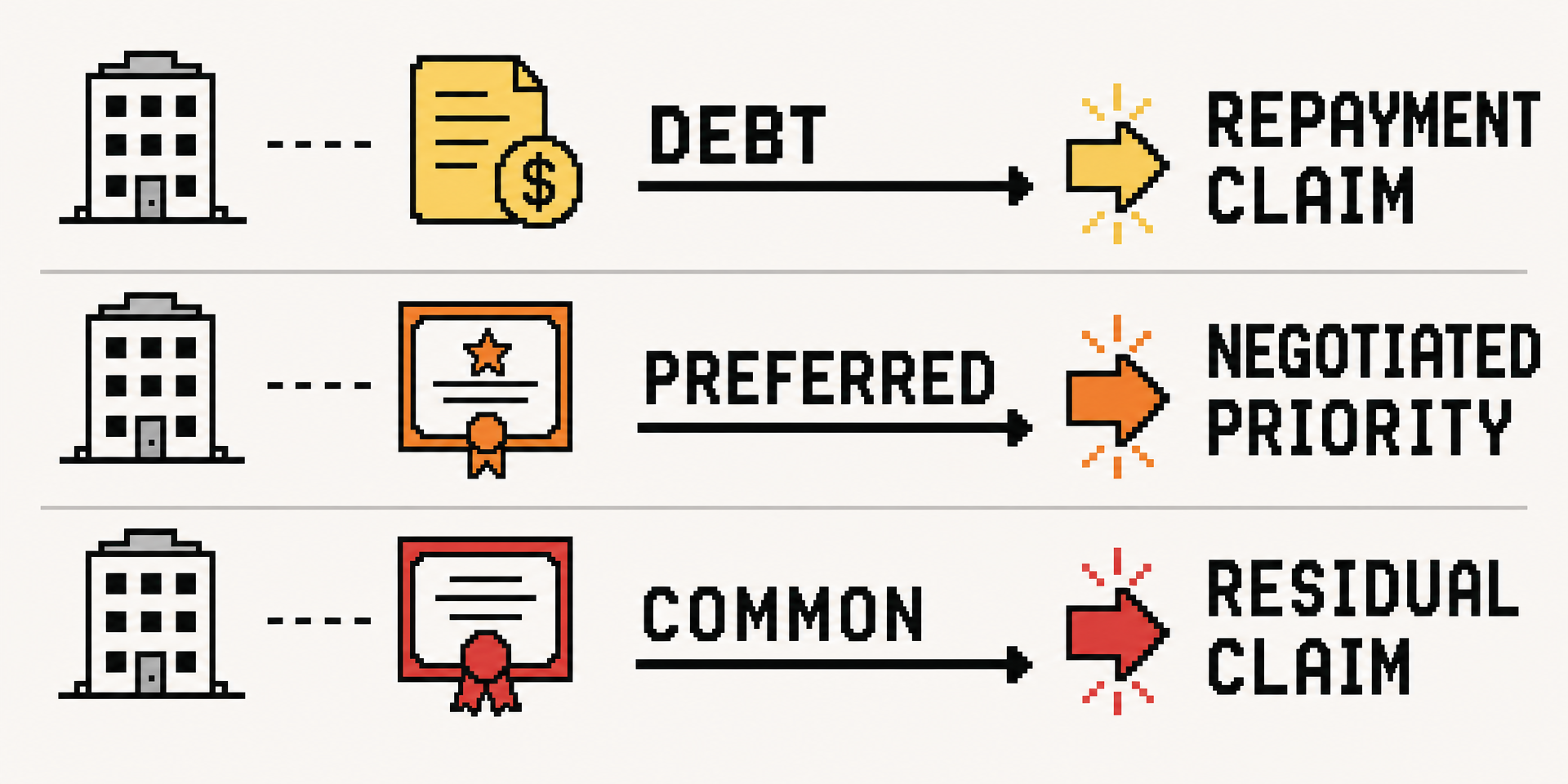
The diagram is a mental model, not a universal legal ladder. A SAFE can have its own cash-out priority, debt can be subordinated, preferred series can rank together or in sequence, and bankruptcy law can produce a different analysis from a merger agreement.
Why capital structure matters to startup investors
The same company can produce different investor outcomes under different financing terms. Five effects deserve separate attention.
Claim priority
A holder can own a meaningful percentage and still sit behind debt and preference claims. Model the proceeds available after transaction costs, creditor claims, and any other senior obligations, then apply the stock terms.
Dilution
New shares, SAFE and note conversions, warrant exercises, anti-dilution adjustments, and option-pool increases can reduce an existing holder's percentage. The detailed math belongs in a dilution guide, not in a single pre-money valuation.
Runway and refinancing
Equity has no scheduled principal repayment. Debt does. Silicon Valley Bank's venture-debt guide says growth-capital loans commonly run three to four years and may begin with six to 12 months of interest-only payments. Those are practitioner observations, not universal terms, but they show why the amortization start and next fundraising date belong on the same calendar.
Control and financing flexibility
Board rights, protective provisions, covenants, pro rata rights, and amendment thresholds can shape the next round. A company may have authorized shares available yet still need approval from a preferred class, lender, or board before issuing them.
Distribution of upside and downside
Debt can provide payment priority while capping upside. Common can absorb the first economic loss while retaining broad upside. Preferred stock, convertible notes, and SAFEs combine downside and upside features differently under their actual terms; they do not occupy one universal middle rung.
Our co-founder and general partner Elizabeth Yin puts the decision discipline succinctly:
“Decisions are never in isolation - they are a comparison game.”
—Elizabeth Yin, Democratizing Knowledge, Hustle Fund, 2021, p. 287
Compare the extra runway with the repayment clock. Compare less dilution now with the risk of a harder financing later. Compare a preference with the valuation and the company's likely range of exits. One term rarely tells you whether the whole structure is sensible.
This is where practice matters. In Angel Squad, our angel-investing community, members learn with real deal-by-deal context and can examine the company thesis separately from the security terms. Every opportunity remains optional, and the documents still control.
How to calculate capital structure without over-trusting one ratio
Two ratios are common starting points:
- Debt-to-equity ratio = interest-bearing debt ÷ equity
- Debt-to-capital ratio = debt ÷ (debt + equity)
Suppose a company has $2 million of interest-bearing debt and $8 million of equity value. Its debt-to-equity ratio is 0.25. Debt makes up 20% of the $10 million total capital figure.
That calculation is tidy. A startup rarely is.
First, “equity value” may be a negotiated private-round price rather than a liquid market value. Second, two companies with the same ratio can have different maturity dates, collateral, covenants, preference stacks, or option pools. Third, SAFEs can sit outside a simple debt-to-equity ratio while still creating future dilution, while convertible notes should be counted as debt before conversion and can also create dilution if they convert.
Use the ratios to ask better questions, not to declare a structure safe. State whether you are using book values, a financing valuation, or another basis. Then pair the ratio with the actual claim and conversion models.
A $15 million exit example
Consider an illustrative company with:
- $1 million of debt due at closing;
- $6 million of Series A preferred with a 1x non-participating preference, senior to Seed;
- $3 million of Seed preferred with a 1x non-participating preference, senior to common; and
- common stock entitled to the residual.
Assume the sale produces $15 million available before these claims. Ignore transaction costs, taxes, accrued interest, escrows, bonuses, other creditors, participation, dividends, and conversion for the moment.
The $1 million debt is paid first, leaving $14 million for equity. Series A takes its $6 million preference. Seed takes $3 million. Common receives the remaining $5 million.
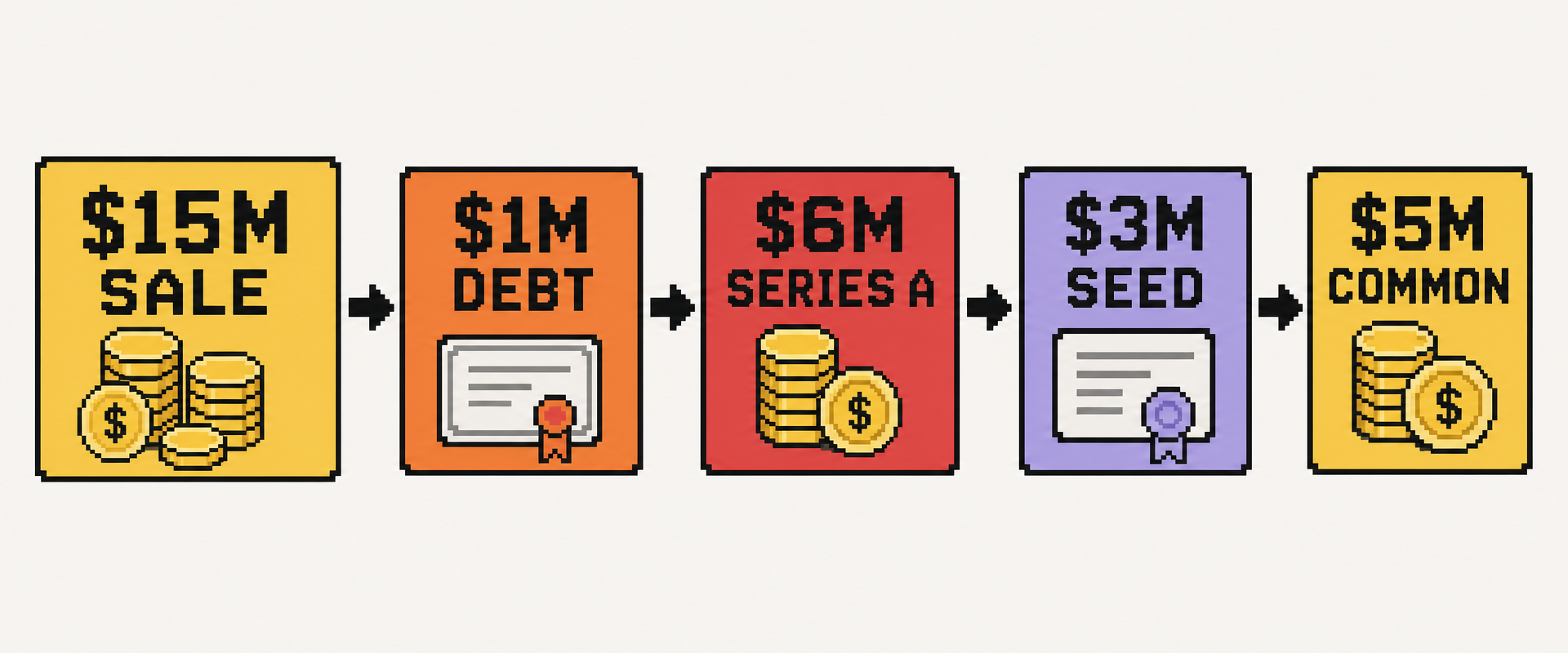
At a higher sale price, a preferred holder may receive more by converting to common. At a lower price, senior claims may consume the entire pool. Participating preferred, accrued dividends, multiple preferences, pari passu series, debt prepayment fees, or a different seniority order would change the result.
That is why “1x preference” is incomplete. Read the multiple, participation, cap, conversion, dividends, and relative seniority together. Cooley's Q1 2026 data reports that the firm handled 165 venture capital financings in the quarter; among the deals in its report, 98.2% had a 1x liquidation preference and 96.4% had non-participating preferred stock. Those figures are a current comparison point, not a substitute for modeling a company's legacy terms.
Our guides go deeper on liquidation preferences and exit payout order.
What is the optimal capital structure?
There is no universal optimal debt-to-equity ratio for a startup. The useful structure is the one the company can service, that funds a credible milestone, and that leaves enough flexibility for a range of outcomes.
Evaluate the choice against:
- Cash-flow predictability: Can the company make scheduled payments in a downside case?
- Runway: Does the financing carry the company past a meaningful operating milestone and leave time for the next raise?
- Collateral and covenants: What assets support the loan, and what actions require lender consent?
- Dilution: How much ownership moves after the round, pool increase, and all conversions?
- Existing senior claims: What must be repaid or preferred before new money participates?
- Control: Which board, class, and protective votes apply?
- Future financing: Will the next investor's capital fund growth or mostly repay the old stack?
- Company stage: A pre-revenue experiment and a company financing a signed receivable do not carry the same repayment risk.
Our debt-versus-equity lens is practical: debt can fit a short need supported by comparatively predictable revenue, while equity can fit uncertainty that cannot support a fixed repayment schedule. Treat that as a question to test, not an underwriting rule.
How to analyze a startup's capital structure
Use the same sequence for every deal.
- Map the legal entities and securities. Identify the issuer, subsidiaries, lenders, stock classes, SAFEs, notes, options, warrants, side letters, and promised grants.
- Reconcile four ownership views. Ask for issued, as-converted, fully diluted, and post-round cap tables. Show authorized-but-unissued shares and the unallocated option pool separately.
- Build outcome waterfalls. Run low, middle, and high sale values. Apply debt, fees, preference multiple, seniority, participation, dividends, caps, and conversion choices in the order required by the documents.
- Model every contingent instrument. Test the expected priced round, a down round, an exit before financing, and no financing before a note's maturity. Add pro rata, most-favored-nation, anti-dilution, warrant, and pool effects where relevant.
- Put debt on the cash calendar. Record draws, interest, fees, interest-only end, amortization, maturity, covenant tests, defaults, cure periods, and mandatory prepayment. Compare those dates with cash zero and the next raise.
- Read control and amendment rights. Reconcile the charter, board approvals, voting agreement, investors' rights agreement, debt documents, and side letters. The NVCA model documents show how many rights can sit outside a cap table.
- Seek independent professional review. Ask questions that can be answered with a document, amount, date, or definition. Before you act, have qualified, independent legal and tax advisers review the documents and assumptions, especially when rights, priority, tax treatment, or filing obligations could change the decision.
The current Form C offers a useful disclosure checklist even when a deal is not a Regulation Crowdfunding offering. It asks about outstanding security classes, material rights, options, valuation methods, and ways other securities may dilute or limit the offered security.
Our co-founder and general partner Shiyan Koh has a direct way to frame the review:
“Show me the incentives, and I'll show you the outcome.”
—Shiyan Koh, Hustle Fund co-founder and general partner, What makes a fund stand out? Shiyan Koh breaks it down, August 7, 2024
Trace who gets paid, who votes, who can block a financing, who must invest again to keep a right, and who benefits from an amendment. If you want to sharpen those questions with other operators and investors, Angel Squad combines investor education, peer discussion, and optional deal-by-deal opportunities. Comparing notes can improve the questions; it does not transfer the decision or risk.
Capital structure red flags
Slow down when:
- the cap table does not reconcile to the charter, ledger, board approvals, or signed instruments;
- a SAFE, note, warrant, side letter, promised grant, or option-pool increase is missing from the fully diluted model;
- debt amortization, a covenant test, or maturity arrives before the expected next financing;
- the next round mainly repays old debt without funding a clear operating milestone;
- the preference stack absorbs most plausible sale proceeds;
- the model shows only an expected up round and ignores a down round, early exit, or note maturity;
- related-party loans, accrued interest, redemption rights, or amendment thresholds are vague;
- a lender's collateral or priority is described more broadly than the documents support; or
- management uses the latest financing valuation as if it were cash available to every shareholder.
One unusual term is not automatically a bad deal. It needs an explanation, a scenario, and a price that makes sense beside the risk.
The bottom line
Capital structure is more than a debt-to-equity ratio. It is the complete financing system behind the company: repayment claims, ownership, preferences, conversion rights, contingent dilution, control provisions, and the ability to raise again.
Read the cap table, then read behind it. Model the downside before the headline exit. Put financing dates beside operating milestones. The goal is not to find a perfect stack. It is to know what you own, what ranks ahead of it, and what has to happen for the company and your investment to reach the next stage.
Want to build that judgment with experienced investors? Apply to Angel Squad to learn the mechanics, examine real opportunities, and make your own deal-by-deal decisions.
This guide provides general educational information only and does not constitute legal, tax, accounting, or investment advice. Capital-structure rights and priorities depend on the entity, jurisdiction, transaction, and signed documents. Before acting on a specific deal, seek independent advice from qualified legal and tax professionals who can review your documents, facts, and jurisdiction.










.png)