
DCF valuation for startups: a practical investor guide
A discounted cash flow model turns a startup's operating story into today's dollars. That sounds precise. The hard part is that a young company's customers, margins, financing needs, and chance of survival may all change before it produces positive cash flow.
So a startup DCF valuation is most useful as an assumption audit. Build the model, expose what has to go right, and compare the result across scenarios. Do not mistake the last cell in the spreadsheet for a guaranteed price.
What a DCF valuation measures
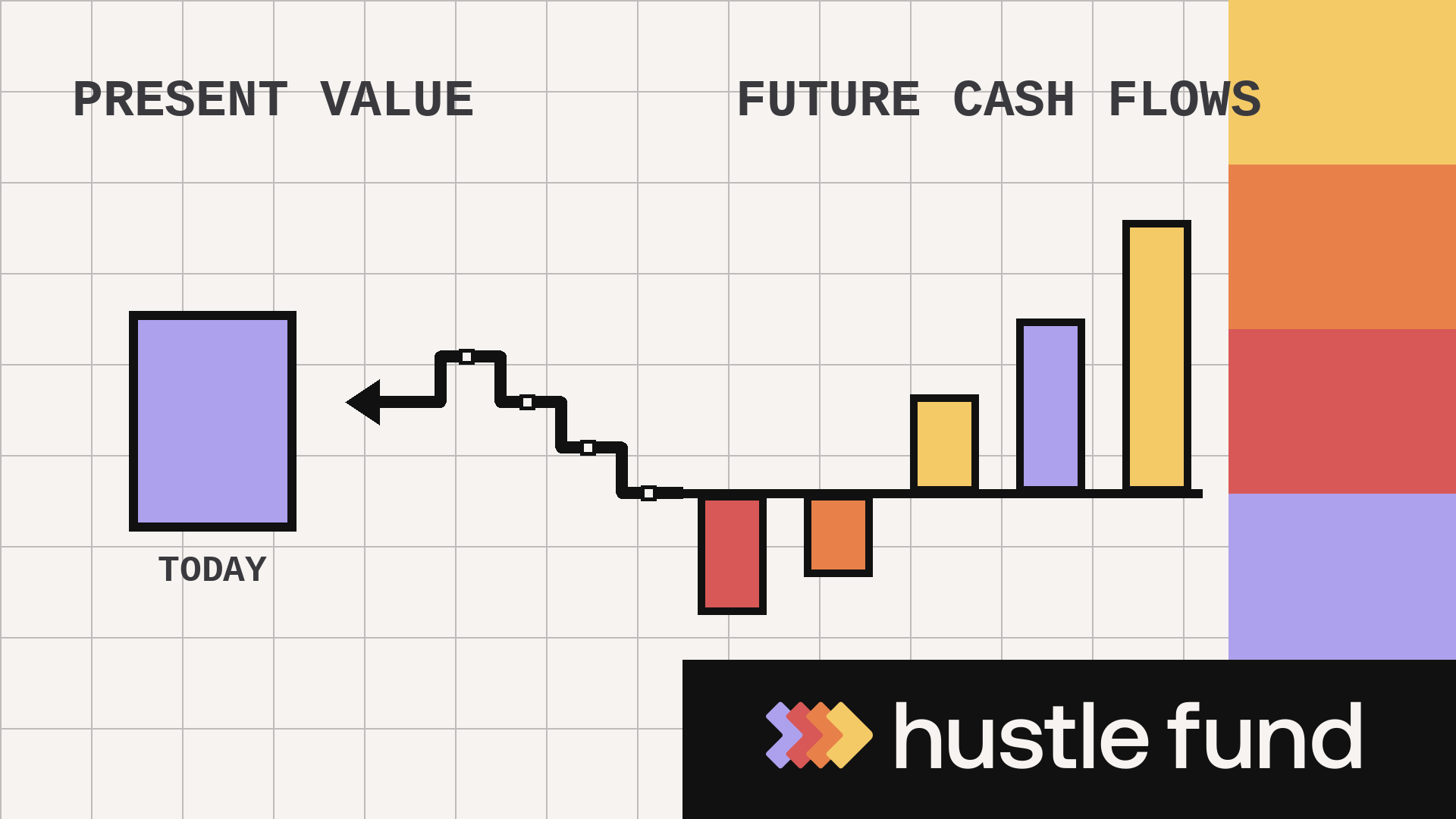
A DCF valuation estimates value by discounting future cash flows back to a valuation date. Cash expected later is worth less than cash today because capital has an opportunity cost and the cash may not arrive.
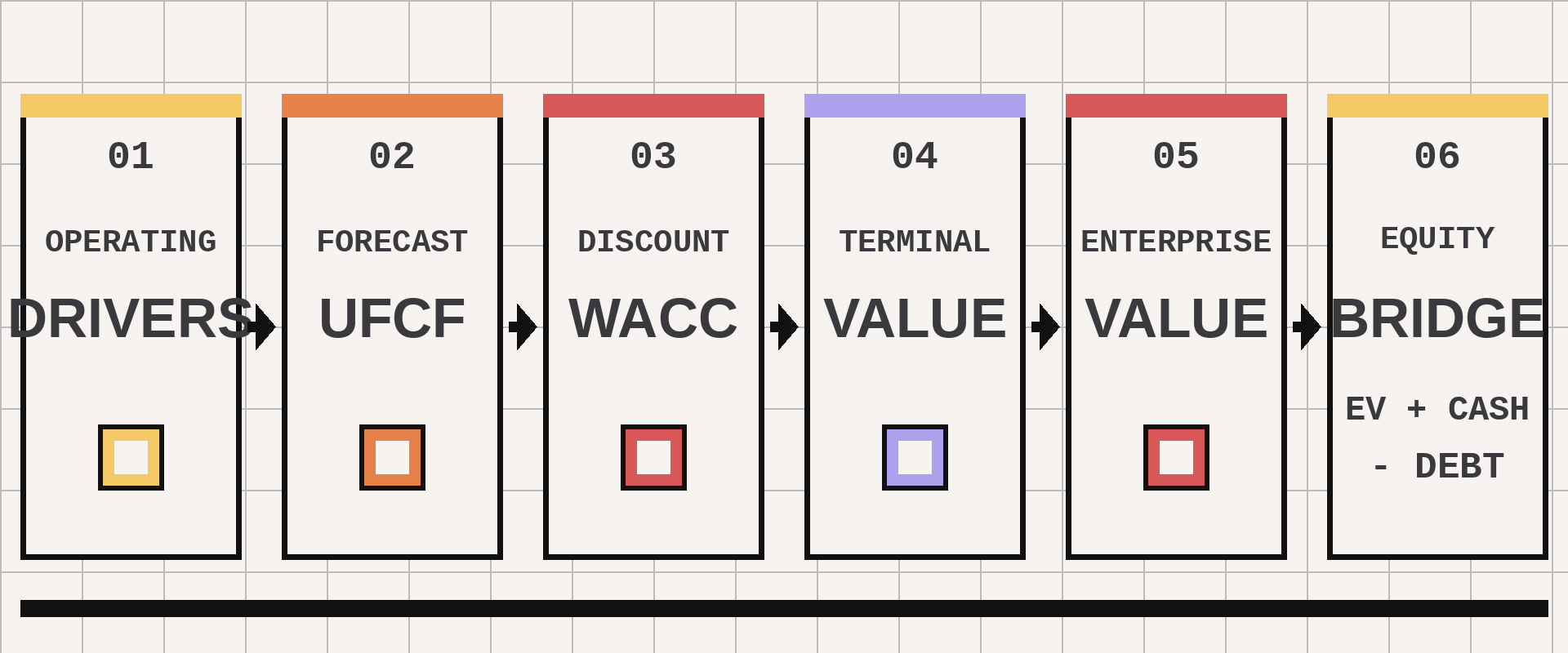
This guide uses an enterprise DCF. It forecasts unlevered free cash flow (UFCF), which is cash generated by operations before debt payments, and discounts that cash at the weighted average cost of capital (WACC). The result is enterprise value, the value of the operating business to debt and equity capital providers.
The general formula is:
Enterprise value = Σ[UFCF in year t / (1 + WACC)^t] + [terminal value in year n / (1 + WACC)^n]
Where:
- UFCF is unlevered free cash flow in each forecast period.
- WACC is the weighted average required return for debt and equity capital.
- t is a forecast period.
- n is the last explicit forecast period.
- Terminal value estimates the value of cash flows after the explicit forecast.
Keep the cash flow and discount rate consistent. UFCF belongs to all capital providers, so it is discounted at WACC. Free cash flow to equity belongs to equity holders, so it is discounted at a cost of equity instead. Mixing UFCF with a cost of equity, or equity cash flow with WACC, breaks the model.
Enterprise value is also not the same as equity value. A simplified bridge is:
Aggregate equity value = enterprise value + excess cash and non-operating assets - debt and debt-like claims
That aggregate amount still does not tell you the value of common equity, a preferred class, or one angel's stake. SAFEs, convertible notes, preferred stock, warrants, and other instruments require their own conversion, capitalization-table, or waterfall treatment rather than an automatic subtraction from enterprise value. Taxes, later financing, and dilution can also change an investor's outcome.
Why a startup DCF is harder than a public-company DCF
A mature public company may have years of financial statements, observable debt pricing, traded shares, and a peer group. A young startup may have none of those.
Professor Aswath Damodaran's paper on valuing young companies identifies the recurring problems: little history, small or no revenue, operating losses, dependence on private capital, and a meaningful risk that the company will not survive. Those are not details to hide inside one aggressive discount rate. They are parts of the operating story that need explicit assumptions.
Five issues deserve extra attention:
- Early free cash flow is often negative. Hiring, product development, customer acquisition, and working capital consume cash before the business reaches scale.
- The forecast can outrun the evidence. A small change in retention, price, sales capacity, or gross margin can compound across the entire model.
- A startup does not have its own traded beta. The discount rate has to be constructed from market inputs and comparable businesses, then adjusted with judgment.
- The terminal value can dominate. Most of the calculated value may sit beyond the years that received detailed forecasts.
- The company may need more financing. A positive enterprise value does not guarantee that today's investor avoids dilution or receives favorable terms in later rounds.
That fragility does not make DCF useless. It changes the question from "What is the company worth?" to "Which operating and financing assumptions would support this range?"
How to build a startup DCF valuation in six steps
1. Fix the valuation date and the model's job
Start with one valuation date. Record the currency, unit scale, forecast-period end dates, and whether cash flows are assumed to arrive at each year-end or throughout the year.
Then write the decision the model is meant to inform. You might be testing an offered financing valuation, comparing two operating cases, or estimating how much value depends on a terminal assumption. A DCF built for one decision should not quietly become proof for another.
Choose the enterprise or equity approach before forecasting. This guide uses enterprise value because startup debt and financing can change, while operating cash flow provides a clearer common starting point.
2. Forecast operating drivers, not a top-line wish
Build revenue from the mechanics of the business. Depending on the model, that could mean customers multiplied by average recurring revenue, transactions multiplied by take rate, or usage multiplied by price.
Forecast the drivers that determine whether revenue becomes cash:
- new customers or units;
- retention, churn, and expansion;
- price and discounting;
- cost to deliver the product and gross margin;
- sales capacity and acquisition cost;
- headcount, compensation, and other operating expense;
- capital spending;
- billing terms, collections, payables, and working capital; and
- the cash and milestones required before another financing.
Tie every material assumption to a date and a source. Actual cohorts, signed contracts, usage, sales capacity, and hiring plans are stronger evidence than an industry average chosen because it produces the desired answer. Our guide to financial projections for angel investors goes deeper on exposing those drivers.
3. Convert the operating forecast into unlevered free cash flow
A common UFCF shorthand is:
UFCF = EBIT x (1 - cash tax rate) + depreciation and amortization - capital expenditures - increase in net working capital
EBIT is earnings before interest and taxes. The formula starts with operating profit, removes cash taxes, adds back noncash depreciation and amortization, and subtracts the reinvestment needed for assets and working capital.
For a loss-making startup, do not create an automatic tax benefit by multiplying negative EBIT by a tax rate. Forecast actual cash taxes and the use of tax attributes consistently with applicable rules and professional advice. The same discipline applies to capitalized development costs, stock-based compensation, deferred revenue, leases, and other items whose accounting treatment differs from cash timing.
Keep negative cash-flow years in the model. Removing them and starting at the first profitable year overstates value because it ignores the capital needed to get there.
In Angel Squad, our angel-investing community, members learn our investing frameworks, review optional startup opportunities, and compare their reasoning with peers. A second set of eyes is useful here because an assumption can be mathematically consistent and still be commercially weak.
4. Build the discount rate instead of copying one
For an enterprise DCF, WACC combines the required return on equity and after-tax cost of debt:
WACC = target market-value equity weight x cost of equity + target market-value debt weight x cost of debt x (1 - usable tax rate)
The clean-looking formula hides several startup problems. There is no quoted share price, the target debt ratio may change, the company may not have market-priced debt, and its own beta cannot be estimated from a trading history.
A defensible build often starts with comparable public businesses:
- Select peers whose operating risk resembles the startup's expected mature business.
- Observe each peer's equity beta and capital structure.
- Remove the effect of peer leverage to estimate an unlevered business beta.
- Use a representative beta and apply a plausible target capital structure.
- Combine the resulting cost of equity with a market-based cost of debt and target market-value weights.
- Reconcile the output with the startup's stage, concentration, financing access, and scenario design.
Damodaran's private-company valuation materials explain the bottom-up beta approach and why private-company cash flows and capital structure require separate judgment. Use a current, valuation-date source such as the U.S. Treasury yield curve for the risk-free input rather than carrying forward an old spreadsheet value.
There is no universal startup WACC. A stage label is not a discount rate, and adding premiums until the result "feels venture-like" can double count risks already reflected in the cash flows or scenarios. A loss-making startup also should not receive the full debt tax shield automatically: the after-tax debt cost depends on whether and when the company can actually use the interest deduction. Document every component, date, peer set, and adjustment.
Our co-founder and general partner Elizabeth Yin makes the process point directly:
“The more disciplined you are in your thought process/rubric...”
Source: Elizabeth Yin, Democratizing Knowledge (Hustle Fund, 2021), p. 131
5. Estimate terminal value only after the startup reaches a stable state
An explicit forecast cannot run forever. Terminal value summarizes cash flows after the last detailed year.
The perpetuity-growth formula is:
Terminal value at year n = UFCF in year n+1 / (WACC - g)
If year n cash flow is the starting point, then UFCF in year n+1 equals year n UFCF multiplied by (1 + g). The long-run growth rate g must be lower than WACC, and the result must still be discounted from year n back to the valuation date.
Do not apply a stable-growth formula to an unstable business. By the terminal year, revenue growth, margins, capital intensity, working capital, tax behavior, and risk should describe a plausible mature company. The terminal discount rate should converge to that mature risk and capital structure; carrying an early-stage rate into perpetuity without explanation is not a coherent steady state. Growth also requires reinvestment. A terminal case that raises growth without funding the assets and working capital needed to support it creates value from nothing.
An exit-multiple terminal value can be a useful cross-check, but it does not make the uncertainty disappear. It replaces a long-run growth assumption with a future market multiple and a future financial metric. Check the implied multiple from the perpetuity model and the implied growth from the multiple model. Investigate a large disagreement rather than choosing the higher answer.
6. Bridge to equity value and test the range
Discount each explicit UFCF and the terminal value to the valuation date, then add the present values. That is enterprise value in this model.
Next, add excess cash and other non-operating assets, then subtract debt and debt-like claims to estimate aggregate equity value. For a startup, inspect bank debt, venture debt, accrued interest, leases, and off-balance-sheet obligations. Then value or allocate SAFEs, notes, preferred stock, warrants, and common equity according to their instrument-specific conversion terms, capitalization table, and payout waterfall. The exact bridge depends on the instruments and the purpose of the valuation.
Now test the result in two ways:
- Sensitivity analysis changes one or two inputs, such as WACC and terminal growth, while holding the rest of the base model constant.
- Scenario analysis changes a coherent set of operating assumptions. A downside case may combine slower sales, lower retention, delayed margin improvement, and another financing need. It should not be the base case with one arbitrary haircut.
Our first-principles view fits this step:
“Going back to first principles is super important...”
Source: Elizabeth Yin, Democratizing Knowledge (Hustle Fund, 2021), p. 288
The model should survive a new market input without losing its logic. If one old benchmark holds the whole valuation together, you have found the assumption to investigate.
A worked startup DCF valuation example
Consider a hypothetical software startup valued as of August 1, 2026. All figures are in millions of U.S. dollars. The five annual forecast periods end July 31, 2027 through July 31, 2031, and each period's cash flow is assumed to arrive at that period-end. The model uses a 28% illustrative WACC and 3% perpetual growth.
The constant 28% rate is an assumption for demonstrating the mechanics, not a recommended startup benchmark or a defensible steady-state rate for a real company. A decision model would need a terminal WACC consistent with the mature operating risk and capital structure described in its terminal case.
The forecast produces these UFCFs:
- Year 1: -$1.20. Discount factor 0.7813; present value -$0.94.
- Year 2: -$0.40. Discount factor 0.6104; present value -$0.24.
- Year 3: $0.80. Discount factor 0.4768; present value $0.38.
- Year 4: $2.20. Discount factor 0.3725; present value $0.82.
- Year 5: $4.00. Discount factor 0.2910; present value $1.16.
The present value of the five explicit cash flows is $1.18 million.
Next, calculate terminal value at the end of year 5:
$4.00 x (1 + 3%) / (28% - 3%) = $16.48 million
Discount that amount for five years:
$16.48 x 0.2910 = $4.80 million
Add the explicit and terminal present values:
Enterprise value = $1.18 + $4.80 = $5.98 million
Assume all $1.50 million of the company's cash is excess or non-operating cash and it has $0.50 million of debt, with no other bridge adjustments in this simplified example:
Aggregate equity value = $5.98 + $1.50 - $0.50 = $6.98 million
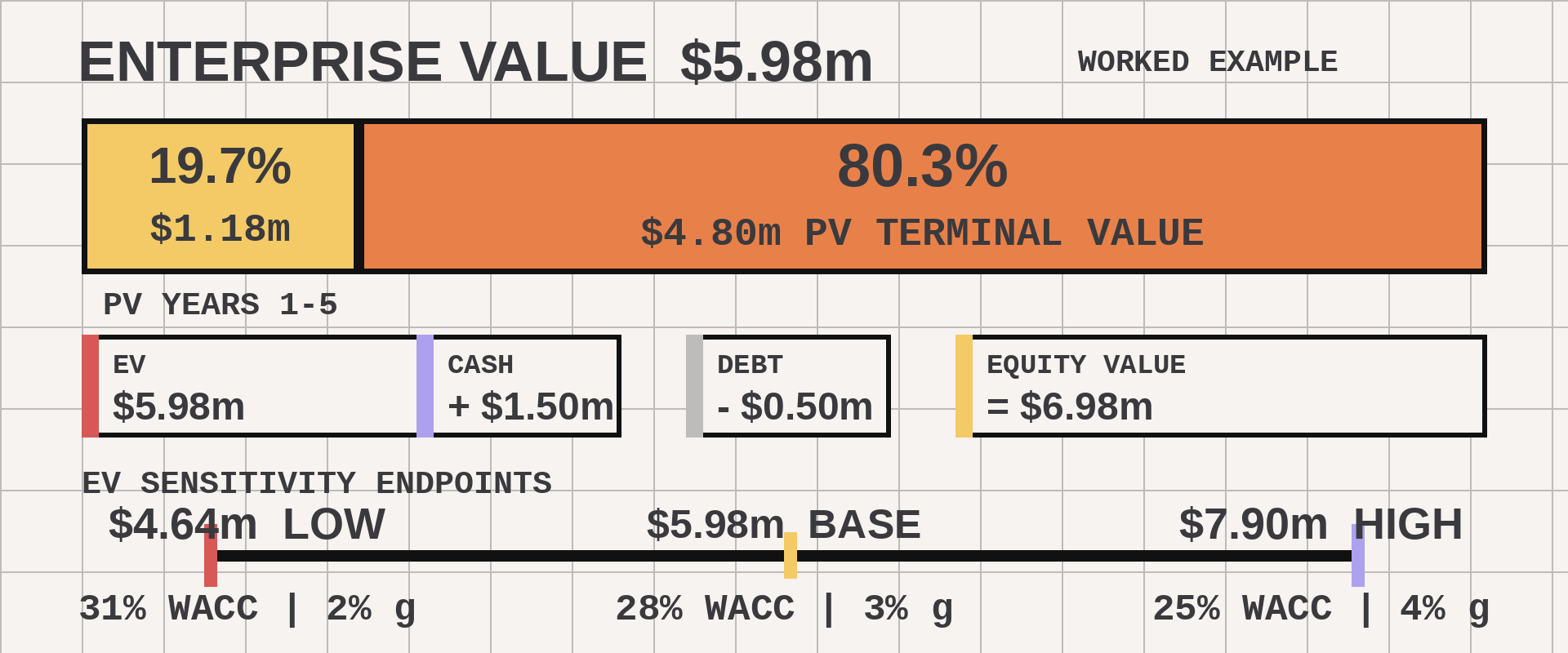
The arithmetic reconciles, but it also exposes the main risk: about 80% of enterprise value comes from the terminal value. That is not automatically wrong. It means the output depends heavily on the business reaching the stable Year 5 state and sustaining the long-run assumptions.
Read the sensitivity as a range, not a menu
Holding the operating cash flows fixed, the enterprise-value sensitivity is:
- At 25% WACC: $7.22 million with 2% terminal growth; $7.54 million with 3%; $7.90 million with 4%.
- At 28% WACC: $5.75 million with 2% terminal growth; $5.98 million with 3%; $6.23 million with 4%.
- At 31% WACC: $4.64 million with 2% terminal growth; $4.80 million with 3%; $4.98 million with 4%.
The same cash-flow forecast produces a $4.64 million to $7.90 million enterprise-value range from those two assumptions alone. The sensitivity does not capture product failure, missed financing, a different margin path, or a shutdown. Put those risks into coherent operating scenarios or probability-weighted outcomes, and document how they interact with the discount rate so you do not count the same risk twice.
For failure risk, add a separate shutdown case rather than hiding it inside one higher WACC. Give the shutdown case its own cash-flow and recovery assumptions, assign company-specific probabilities to it and the operating cases, and calculate the probability-weighted range. Then check that you have not counted the same failure risk again in the cash flows, scenario probabilities, and discount rate.
When a startup DCF is useful
A DCF becomes more decision-useful when:
- revenue has observable drivers, even if the company is not profitable;
- retention, price, gross margin, and acquisition evidence can anchor the forecast;
- management has a credible plan for hiring, capital spending, and working capital;
- the model reaches positive free cash flow without hiding the funding required to get there; and
- you can describe a plausible stable business at the end of the explicit forecast.
It is weaker when the startup is pre-product, pricing is untested, the outcome is binary, the business model is changing, or the company needs several unfunded rounds before the forecast becomes observable. In those cases, a DCF can still reveal what must be true, but it should not carry the decision alone.
Use market and venture methods as cross-checks. Comparable financings show what investors have paid for related risk. A venture capital method works backward from a possible exit and target return. Scorecard and milestone methods can organize qualitative early-stage evidence. None is automatically correct; each answers a different question. Our broader startup valuation guide explains those neighboring methods.
A startup DCF review checklist
Before relying on the range, verify:
- The valuation date is fixed. Every market input and balance-sheet amount matches that date.
- Revenue is driver-based. Customers, usage, price, retention, and sales capacity reconcile.
- Growth is funded. Hiring, acquisition, capital spending, and working capital reflect the plan.
- Cash flow and discount rate match. UFCF uses WACC; equity cash flow uses cost of equity.
- Taxes are modeled as cash. Losses do not create an unsupported tax benefit.
- The discount rate is traceable. Peer betas, leverage, risk-free rate, risk premium, debt cost, and weights are dated.
- The terminal state is mature. Growth, margins, reinvestment, taxes, and risk tell one coherent story.
- The terminal share is visible. You know how much enterprise value comes from the period beyond the detailed forecast.
- The equity bridge is complete. Cash, debt, preferred claims, convertibles, and other obligations are addressed.
- Dilution and security terms are separate. Enterprise value does not replace a cap-table and waterfall analysis.
- Sensitivities and scenarios are both present. The model shows parameter uncertainty and different operating paths.
- Open questions are preserved. Record them in an investment memo and update the evidence without rewriting the original thesis.
Repeating the same checklist builds pattern recognition. Angel Squad gives members a place to learn our frameworks and discuss optional opportunities with other operators and investors. Community can challenge a model; it cannot remove the underlying risk or make the decision for you.
The useful output is a better question
A startup DCF should leave you with more than an equity-value cell. It should show which customer, margin, financing, discount-rate, and terminal assumptions control the decision, and how far the answer moves when those assumptions change.
Private startup investments remain speculative and illiquid. Investor.gov warns that private placements can involve a total loss and an indefinite holding period. A model does not change that. This guide is educational information only, not personalized investment, legal, or tax advice. Only invest money you can afford to lose, and get qualified financial, tax, and legal advice for your circumstances.
If you want to practice disciplined startup analysis with our frameworks and a community of peers, apply to Angel Squad. Every opportunity is optional, and every investment decision remains yours.










.png)