
Right of first refusal: how private-share transfers really work
Private shares can look transferable until a real buyer appears. Then a right of first refusal can change the buyer, stretch the timetable, or send the parties back to the beginning.
For an angel investor, the clause matters twice: when you want liquidity and when you get a chance to buy more. The details live in the signed documents, so you need to understand the full transfer workflow before anyone prices a deal or wires money.
What is a right of first refusal?
A right of first refusal (ROFR, pronounced “rofer”) is a contractual right, without an obligation, to buy an asset before its owner completes a sale to someone else. In a private-company share transfer, the holder can usually step into a proposed third-party deal by matching the price and other required terms.
The outside offer typically sets the terms. The ROFR does not automatically force a shareholder to sell, set a price, or let its holder buy whenever it wants. It becomes relevant when a covered holder proposes a covered transfer and follows the trigger written into the agreement.
The company may hold the first right. Named investors may have a secondary refusal right over shares the company does not buy. The restriction may cover founder common stock while excluding investor preferred stock, or it may reach a wider group. “The company has a ROFR” tells you very little until you know the scope.
For Delaware corporations, Section 202 expressly permits written stock-transfer restrictions that give a company, stockholder, or another person a prior opportunity to acquire restricted securities. It also addresses where a restriction must be noted and when actual knowledge matters. Other governing laws and the company's own documents can change the analysis.
This is general education, not legal, tax, or investment advice. Private-share transfers require independent review by qualified securities and tax professionals who can assess the actual documents, parties, and jurisdictions.
Do not confuse a ROFR with these rights
Similar labels hide different mechanics:
- Right of first offer (ROFO): The seller approaches the holder before soliciting an outside offer. If they do not agree, the seller may then seek another buyer, subject to the clause.
- Preemptive or pro rata right: An investor gets a chance to buy part of a new company issuance, usually to maintain an ownership percentage. A share-transfer ROFR usually concerns already-issued shares sold by an existing holder.
- Consent right: The company or board can approve or reject a transfer. It does not have to buy the shares to say no.
- Co-sale or tag-along right: Eligible holders can add some of their own shares to another holder's sale. This can reduce the original seller's allocation.
“Going back to first principles is super important since the market always changes and evolves.”
Source: Elizabeth Yin in Democratizing Knowledge, Hustle Fund co-founder and general partner
That principle fits here. “Standard ROFR” is shorthand. The trigger, covered shares, priority, deadlines, matching standard, exemptions, and remedies are the actual deal.
How a private-company ROFR works
A share-transfer ROFR usually follows seven stages.
- Map the governing documents. Start with the charter, bylaws, stock purchase or award agreement, investor rights documents, ROFR and co-sale agreement, side letters, amendments, and any transfer policy. Identify which document wins if terms conflict.
- Form the outside deal. The seller obtains a bona fide third-party offer or signs a conditional purchase agreement. It should state the buyer, shares, class, price, payment form, closing date, and every material condition.
- Deliver the transfer notice. The seller sends the notice to every required recipient, using the exact delivery method and address in the agreement. An incomplete notice may never start the clock.
- Run the first decision window. The company decides whether to buy all or part of the offered shares. Board approval and corporate funding may be required.
- Run any investor and co-sale windows. If the company leaves shares available, eligible investors may receive a pro rata purchase right, an oversubscription opportunity, or a chance to join the sale.
- Close on the cleared terms. If the holders pass, the seller may close with the named outside buyer during a limited period and on terms no more favorable than those in the notice. A lower price, different buyer, deferred payment, or new side deal may restart the process.
- Record the transfer. The buyer may need to sign a joinder, satisfy securities-law conditions, deliver tax forms, and accept legends or continuing restrictions before the company or transfer agent updates the stock ledger.
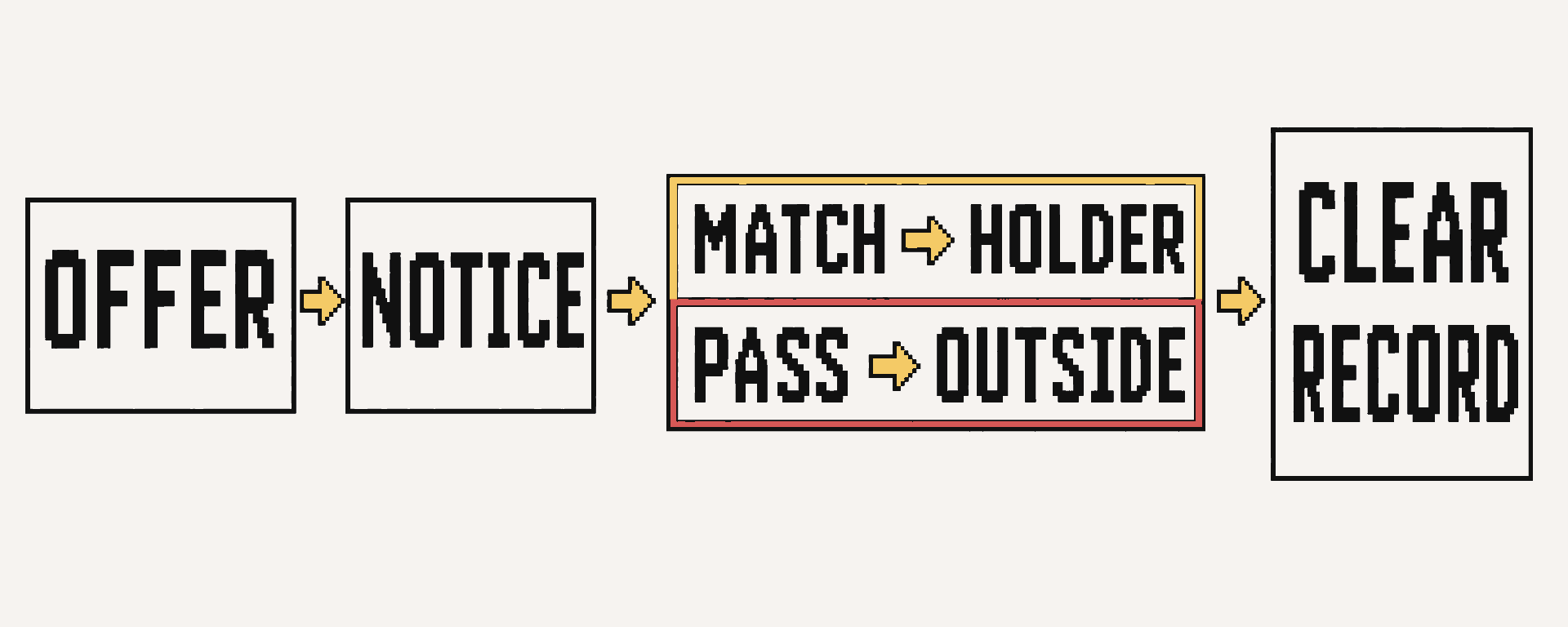
There is no universal response period. The April 2026 NVCA model agreement illustrates one possible cascade: its bracketed notice period is 45 days before the proposed transfer, the company has 15 days after delivery to exercise, and an investor must respond within ten days after the company's deadline for its secondary notice. The form then includes an undersubscription process and other bracketed choices. It is a drafting model, so the executed agreement controls.
A $400,000 example
Suppose a founder agrees to sell 100,000 common shares to an outside buyer for $4 per share in cash. The transfer notice names the buyer, includes the purchase agreement, and uses the model's bracketed 45-day lead time for this illustration.
If the company matches the entire offer, the founder still receives $400,000 on the agreed terms. The company becomes the buyer, and the outside buyer receives no shares.
If the company elects to buy 60,000 shares and eligible investors buy the remaining 40,000, the founder can still sell the full block. The purchase money comes from two internal tiers.
Now suppose only 60,000 shares are subscribed. Some agreements permit a partial internal purchase. Others use an all-or-nothing mechanism under which an incomplete exercise causes the company and investors to forfeit their purchase rights for that proposed transfer. The outside buyer may then buy the full 100,000-share block. You cannot infer the result from the words “right of first refusal.”
If the outside buyer later negotiates the price down to $3.75 per share, the cleared offer and the closing deal no longer match. The seller may have to issue a new notice and run every clock again.
Noncash terms make matching harder. Seller financing, earnouts, escrow, bundled assets, employment arrangements, and unique services all have value beyond the headline share price. A good clause states how noncash consideration is valued and whether a ROFR holder may pay an approved cash equivalent.
What a ROFR means for each party
The selling shareholder
A valid exercise can preserve the seller's economics because the holder takes the buyer's place. It can also make liquidity harder to find.
An outside buyer may spend money on diligence and negotiation only to set a price for someone else. A law-and-economics analysis by David I. Walker explains how those search and negotiation costs can deter bidders and reduce a seller's expected proceeds. The effect is especially relevant for closely held shares, which are hard to value and rarely trade.
The seller should build the ROFR timeline into the purchase agreement, disclose the process before the buyer incurs major expense, and avoid promising a closing date the company documents cannot support. Our guide to selling shares before an exit covers the wider liquidity problem.
The outside buyer
The buyer has deal risk even after agreeing on price. The company or an investor may replace it, a co-sale right may shrink the available block, or a consent right may stop the transfer.
A careful buyer makes the purchase conditional on documented ROFR clearance and every separate approval. The agreement should say what happens to a deposit, who pays transaction costs if the ROFR is exercised, how confidential information may be used, and when either party can walk away. The buyer should not pay as though allocation is certain.
The company or investor holding the right
A ROFR holder gets access to a priced block and some control over who joins the cap table. It does not get a free pass on diligence.
The shares may be common stock with fewer rights than the preferred stock you already own. The company's latest financing price may have involved preferences, information rights, or other protections that do not travel with the secondary shares. Compare the security, fully diluted ownership, price, transfer restrictions, taxes, and realistic liquidity horizon.
“Decisions are never in isolation - they are a comparison game.”
Source: Elizabeth Yin in Democratizing Knowledge, Hustle Fund co-founder and general partner
Exercising a ROFR is a fresh capital-allocation decision. Compare it with follow-on reserves, new deals, and your existing concentration. In Angel Squad, our angel-investing community, members learn with peers and apply repeatable deal-analysis frameworks to choices like this. That peer work supports judgment. It does not replace independent legal or tax review, and membership does not guarantee an investment or allocation.
Nine questions to clear before a transfer
The best ROFR diligence produces a clean transaction file. Work through these questions in order.
- Which executed document creates the right? Collect every amendment, joinder, waiver, and side letter. A cap-table note or verbal summary is not the clause.
- Which seller, shares, and transactions are covered? Define the share class, minimum block, direct and indirect transfers, pledges, gifts, affiliate transfers, estate-planning transfers, and changes of control in a holding entity.
- Who holds each right, and in what order? Identify the company tier, investor tier, pro rata allocation, oversubscription method, and the decision-maker for each holder.
- What makes notice complete? Confirm required attachments, material terms, buyer identity, price, consideration, proposed date, delivery method, and proof of receipt.
- What must be matched? Read beyond price per share. Payment timing, escrow, representations, indemnities, fees, financing conditions, and side arrangements may be material.
- When does each clock begin and end? Distinguish calendar days from business days, receipt from delivery, and an exercise deadline from a funding or closing deadline. Note when a third-party sale window expires.
- Which restrictions survive a ROFR pass? Board consent, prohibited-transferee rules, co-sale rights, lockups, securities legends, transfer-agent instructions, information-access limits, and joinder requirements can remain in force.
- What securities-law and tax gates remain? A ROFR waiver is contractual clearance only. Every offer and sale needs registration or an available exemption for that transaction. Accredited-investor status alone is not an exemption, and the exemption used for the original issuance does not automatically cover the resale. The SEC's private-secondary guidance also makes clear that federal and state requirements can overlap. Rule 144 or another resale pathway does not override a ROFR, consent right, legend, or transfer-agent process.
- What written evidence will close the file? Keep the offer, notices, delivery proof, exercise decisions or waivers, board consent, co-sale calculations, securities-law support, joinders, payment evidence, and confirmation that the ledger was updated.
This is where disciplined paperwork pays off.
“The more disciplined you are in your thought process/rubric, the more you can improve over time.”
Source: Elizabeth Yin in Democratizing Knowledge, Hustle Fund co-founder and general partner
Use our broader angel diligence checklist for the company, team, cap table, and deal terms. The ROFR checklist then handles the transfer itself.
Common ROFR mistakes
Most failures are procedural rather than philosophical:
- Treating silence as a waiver. Silence may let a deadline expire, but only if valid notice started the clock and the agreement says nonresponse is a pass. Written confirmation is cleaner.
- Clearing the price while changing another term. A side letter, longer payment schedule, added indemnity, or different buyer can make the final sale more favorable and require a new process.
- Assuming a ROFR pass approves the transfer. Consent rights, co-sale rights, prohibited-transferee provisions, and securities restrictions operate separately.
- Using a family or affiliate exemption as a permanent escape. An exempt transferee may still have to join the agreement, and the shares may remain restricted for its later sale.
- Ignoring partial-exercise rules. The clause may allow partial purchases, require the entire block to be taken, or allocate leftovers through oversubscription.
- Closing before the stock ledger changes. A signed buyer-seller agreement does not ensure the company will recognize a noncompliant transfer. Some agreements authorize stop-transfer instructions and equitable remedies.
Right of first refusal FAQ
Can a company block a share sale without buying the shares?
A pure ROFR gives the holder a chance to match. If it passes, the seller can generally proceed under the clause's conditions. A separate consent right, prohibited-buyer rule, lockup, or securities restriction may still block the transaction without requiring the company to buy.
Does a ROFR apply to a startup's next financing round?
A share-transfer ROFR usually applies to outstanding shares sold by a shareholder. A preemptive or pro rata right usually covers new shares issued by the company. Some documents use loose labels, so the operative language controls.
Is a written ROFR waiver always required?
The agreement may treat a properly noticed deadline as sufficient. A buyer still wants a written waiver or confirmation showing who declined, what offer was cleared, when each period ended, and which other approvals remain outstanding.
When does a ROFR expire?
The clause sets the term. It may end before an initial public offering, at a qualifying company sale, on a fixed date, or through an amendment or waiver. Passing once usually clears one proposed transfer, rather than erasing the right forever.
The real deliverable is a clean transfer file
A right of first refusal is a transaction workflow. The offer starts it, the documents route it, the notices run it, and written clearance proves the result. Investors who treat it as a one-line definition risk buying shares that cannot be recorded or selling on terms that have to be offered again.
If you want to build this level of deal discipline alongside experienced operators while learning how early-stage investing works, apply to Angel Squad.










.png)