
How to read a capitalization table: An investor's guide
A capitalization table, usually called a cap table, maps a startup's ownership. For an investor, it should answer two questions: who has a claim on the company today, and how could those claims change when options are exercised, convertible instruments convert, or new shares are issued?
The arithmetic is simple only when the inputs are complete. A polished table can still hide a stale date, an undefined denominator, or a stack of SAFEs that has not been modeled. Read the cap table as a set of assumptions to verify, not as a verdict on the investment.
The examples use common U.S. venture-backed corporation conventions. Terms, rights, and tax treatment vary by entity and jurisdiction. This is general education, not legal, tax, accounting, or investment advice; consult your own advisers.
What a capitalization table can and cannot tell you
A complete cap table identifies each holder, the security they hold, the number of shares or units, and an ownership percentage as of a specific date. A complete diligence package also includes separate schedules for options, warrants, the employee equity pool, Simple Agreement for Future Equity instruments (SAFEs), convertible notes, and financing scenarios.
That makes the cap table useful for assessing:
- who owns the company;
- how concentrated the ownership is;
- how much equity remains available for employee grants;
- how much potential dilution is already embedded in outstanding instruments; and
- how a proposed round may change each holder's stake.
But a cap table is not the full legal or economic story. The U.S. Securities and Exchange Commission notes that common and preferred stock can carry different voting and economic rights. Those rights live in the company's charter and financing agreements, not in the word “preferred” on a spreadsheet.
The same limit applies to exit proceeds. A 10% fully diluted stake does not automatically receive 10% of a sale. Liquidation preferences, participation rights, seniority, dividends, conversion choices, and debt may change the payout. The cap table tells you what securities exist; an exit waterfall models how the proceeds could flow.
Read the cap table in three views
Do not start by scanning the ownership percentages. Start by asking which version of ownership you are looking at.
- Current outstanding ownership shows shares that have been issued and remain outstanding now.
- Current fully diluted ownership adds potential shares under a stated set of assumptions.
- Post-financing pro forma ownership models what the table could look like after a proposed transaction.
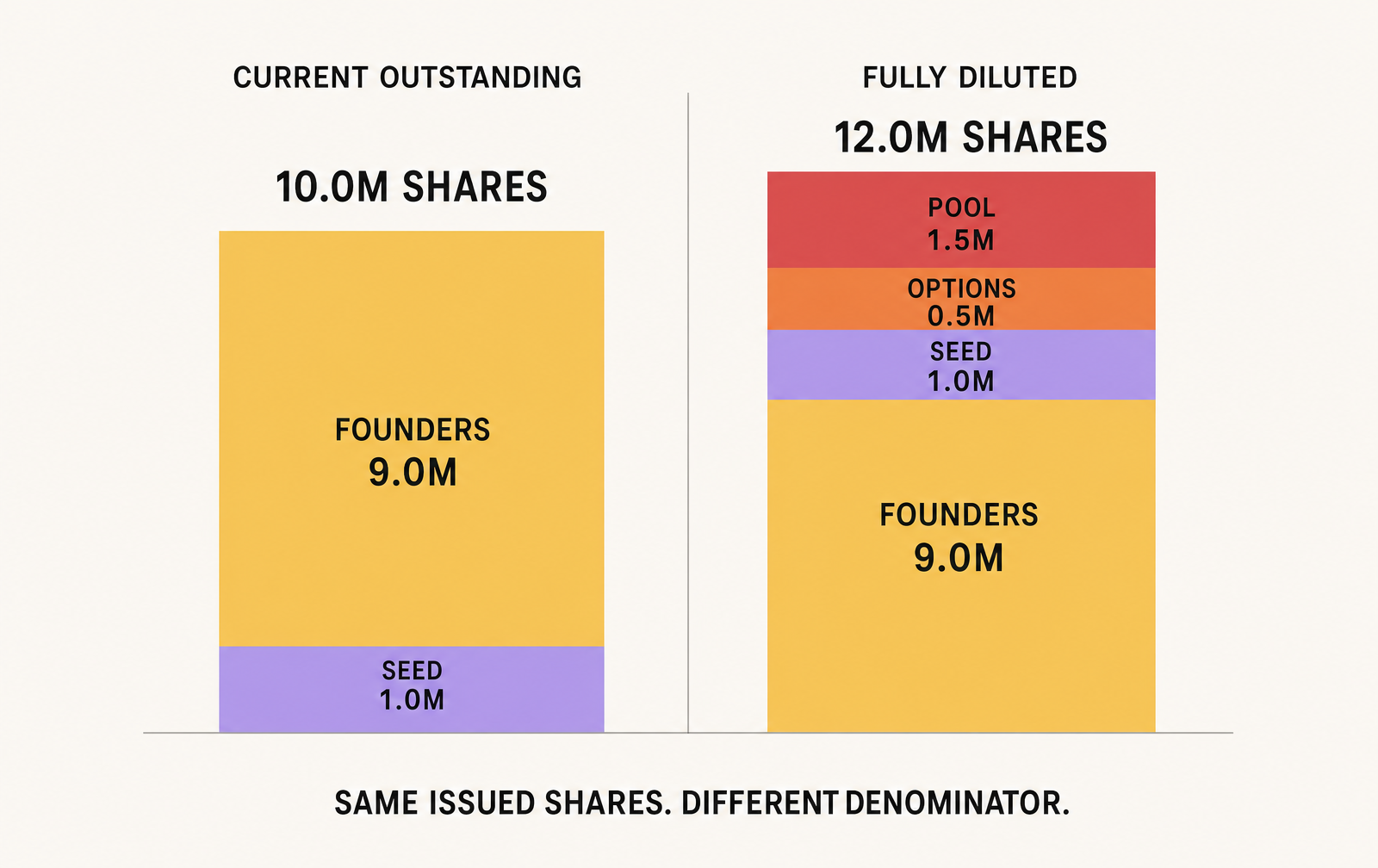
Every view needs an as-of date. Every percentage needs a denominator. “The founders own 60%” is incomplete until you know whether that means 60% of current outstanding shares, current fully diluted shares, or the post-financing company.
Current outstanding ownership
Issued and outstanding shares have been issued by the company and are still held by shareholders. For a typical venture-backed corporation, that may include founder common stock, exercised employee shares, and investor preferred stock.
An unexercised option is different. It gives the holder a right to buy shares under its terms, but the underlying shares are not yet outstanding. An unallocated option pool also has no current owner. Those items matter for potential dilution, so they usually belong in a fully diluted view rather than the outstanding-share count.
When comparing share classes, convert them to a common-equivalent basis only under the actual conversion ratio. Do not assume every preferred share converts one-for-one.
Current fully diluted ownership
Fully diluted ownership is a scenario, not a second legal share register. It usually starts with outstanding shares on an as-converted basis, then adds potential shares from items such as:
- granted options, whether vested or unvested;
- shares left in the employee option pool;
- warrants;
- restricted stock units or other equity awards that may settle in shares; and
- SAFEs or convertible notes when their conversion can be modeled.
There is no safe shortcut here. “Fully diluted” must come with its assumptions. One table may include the entire unallocated option pool but show SAFEs separately. Another may include estimated SAFE conversions but exclude a proposed pool increase. Ask for a line-by-line definition of the denominator.
Post-financing pro forma ownership
A pro forma cap table gives effect to a contemplated financing. It should start with the current ownership, convert any instruments triggered by the round, add any negotiated option-pool increase, issue the new shares, and calculate the resulting percentages.
This is the view that connects pre-money and post-money valuation to what you may own. It is also where small assumption changes can produce large differences. A pro forma should show the formulas alongside the final percentages.
Know what each row represents
A tidy label can conceal very different rights and stages of ownership. Work across the table one security type at a time.
Common and preferred stock
Founders and employees commonly hold common stock. Outside investors commonly hold a series of preferred stock. That convention does not tell you the terms.
For each class or series, check:
- shares outstanding and the conversion ratio;
- votes per share and any class vetoes;
- liquidation preference and participation terms;
- dividend rights;
- anti-dilution provisions;
- pro rata or participation rights;
- board appointment rights; and
- seniority relative to other series.
The company's charter, stock purchase agreement, investors' rights agreement, voting agreement, and related documents should answer those questions. The NVCA model legal documents are a useful illustration of how many separate agreements can sit behind one preferred-stock row.
Also separate authorized shares from outstanding shares. Authorized shares are the company's issuance capacity under its charter. They are not ownership, and they should not appear in the denominator merely because the company could issue them someday.
Options, warrants, and the employee pool
Break the equity plan into at least three buckets:
- Issued plan shares: shares already issued and outstanding, including shares from exercised options and issued restricted stock awards, as applicable.
- Granted but unissued awards: options, restricted stock units, or other awards that have been granted but not yet exercised or settled.
- Unallocated pool: shares reserved under the plan but not yet granted to anyone.
This split tells you whether the pool can support the company's hiring plan and how much dilution is already in the fully diluted number. It also surfaces “promised” grants that may not yet be formally approved.
Then ask whether the financing requires a pool increase. If the additional pool is inserted into the pre-money fully diluted capitalization, existing holders generally absorb that dilution before the new investor's shares are priced. That is a negotiated sequencing point, not a law of nature. Model it both ways and make the agreed treatment explicit.
Warrants need their own line or schedule. Record the number of underlying shares, exercise price, expiration, and adjustment provisions. A warrant for 100,000 shares is not equivalent to 100,000 outstanding shares today, but it may belong in the fully diluted denominator.
SAFEs and convertible notes
SAFEs and convertible notes are easy to miss because they may sit outside the main ownership table. They still belong in your diligence.
The SEC distinguishes them clearly: a SAFE promises a future ownership interest if a triggering event occurs, while a convertible note is a loan that can convert into another security. A SAFE holder does not own shares merely by signing the SAFE. A note remains debt until it converts or is otherwise resolved.
For every instrument, request a schedule showing the holder, investment or principal amount, issue date, valuation cap, discount, interest rate, accrued interest date, maturity date, conversion trigger, most-favored-nation provision, pro rata side letter, and amendments. Use the signed instrument to determine which fields apply.
Y Combinator's current SAFE financing documents explain one important convention: ownership under its post-money SAFE is measured after all SAFE money but before the new money in the priced round. Under a standard post-money valuation-cap SAFE, a $500,000 investment at a $10 million post-money cap implies about 5% after the SAFE financing and before the next round's new money, subject to the agreement's definitions and the actual conversion path. It is not 5% forever.
A priced round can dilute that position. So can an option-pool increase. Modified SAFEs may work differently. Read the paper and model each instrument rather than relying on the word “post-money.” Our plain-English guide to how SAFEs convert goes deeper on the mechanics.
Our co-founder and general partner Eric Bahn warns about stacked pre-money SAFEs: “It is really easy to mess up these calculations when you have so many different kinds of pre-money valuations stacking on top of each other…” That is why the instrument schedule and conversion model belong beside the current cap table, even when the SAFEs themselves are not yet listed as shares.
Convertible notes add another variable: accrued interest. When the future share count cannot yet be calculated, startup counsel Cooley recommends keeping a separate note ledger and then reflecting the conversions in the financing pro forma. Its convertible debt guide is a useful reminder that a clean current cap table can still be incomplete without the adjacent debt schedule.
A capitalization table example
Consider a startup with the following ownership. To keep the example focused, assume the preferred stock converts one-for-one and there are no warrants, SAFEs, notes, restricted stock units, or promised grants.
Here is the same ownership snapshot without compressing the assumptions into a grid:
- Founders: 9,000,000 common shares are currently outstanding and count as 9,000,000 shares on the fully diluted basis.
- Seed investors: 1,000,000 preferred shares are currently outstanding; on the assumed one-for-one as-converted basis, they also count as 1,000,000 fully diluted shares.
- Employees: 500,000 granted but unexercised options are not currently outstanding; they count as 500,000 shares on the fully diluted basis.
- Unallocated employee pool: 1,500,000 reserved options are not currently outstanding; they count as 1,500,000 shares on the fully diluted basis.
- Totals: 10,000,000 shares are currently outstanding, compared with 12,000,000 shares on the stated fully diluted basis.
On the outstanding-share basis, the founders own 90% and the seed investors own 10%.
On the stated fully diluted basis, the same founders own 75%, the seed investors own 8.33%, granted options represent 4.17%, and the unallocated pool represents 12.5%.
No shares changed hands between those two views. The denominator changed. That is why any ownership percentage without its basis is nearly useless.
Model a new financing before you invest
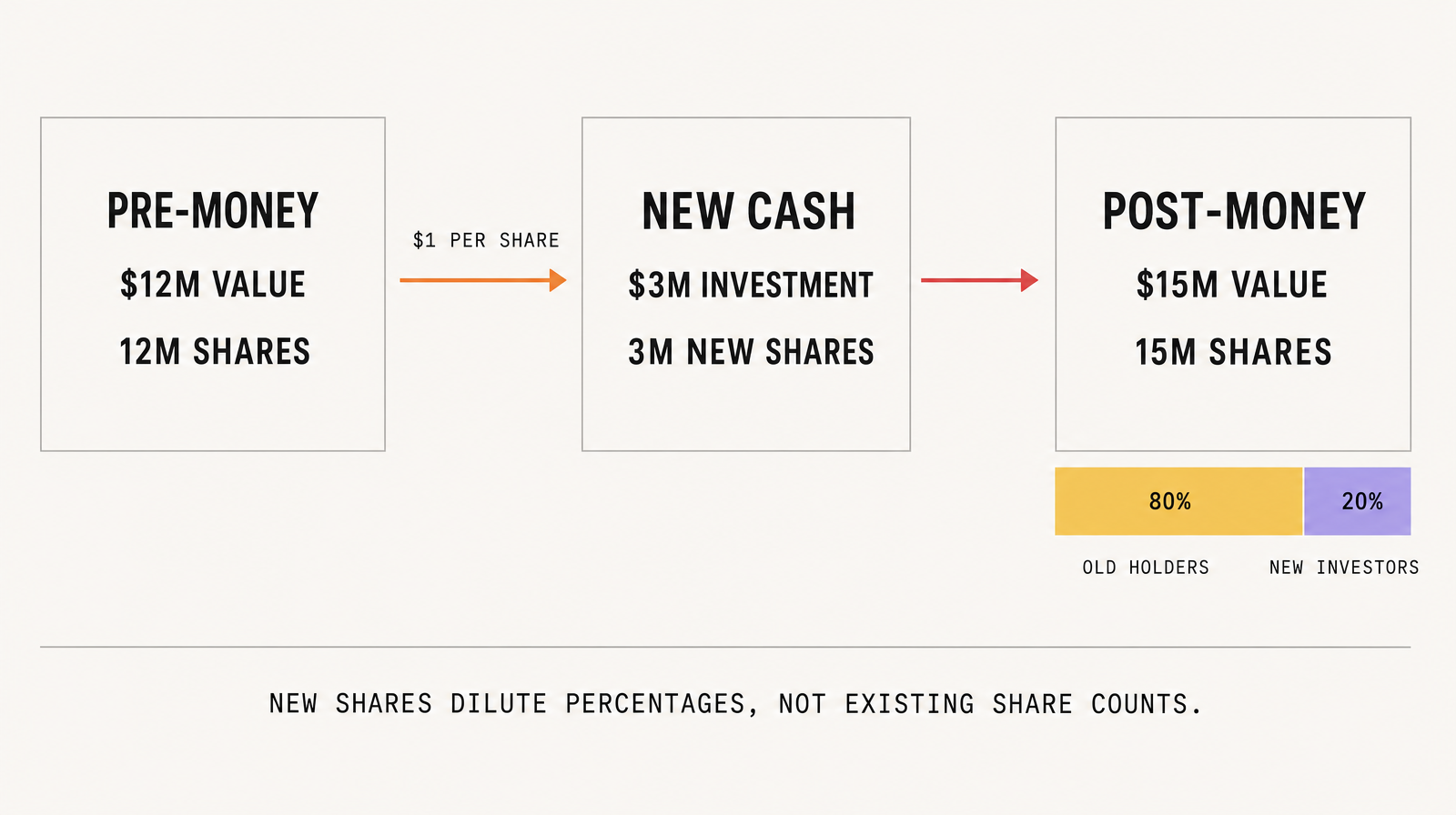
Now assume the company raises $3 million at a $12 million pre-money valuation. Keep the earlier assumptions: 12 million fully diluted pre-money shares, no convertible securities, no pool increase, one close, and no fees added to the financing.
- Calculate the share price: $12 million pre-money value ÷ 12 million pre-money fully diluted shares = $1 per share.
- Calculate the new shares: $3 million investment ÷ $1 per share = 3 million new shares.
- Calculate post-money shares: 12 million existing fully diluted shares + 3 million new shares = 15 million.
- Check the new investor's stake: 3 million ÷ 15 million = 20%.
The percentage changes are:
- Founders: 75.00% before the financing and 60.00% after it.
- Seed investors: 8.33% before the financing and 6.67% after it.
- Granted employee options: 4.17% before the financing and 3.33% after it.
- Unallocated employee pool: 12.50% before the financing and 10.00% after it.
- New investors: 0.00% before the financing and 20.00% after it.
- Total: 100.00% before the financing and 100.00% after it.
The new money bought 20% of the post-money company. Every pre-financing line retained the same number of shares but now represents 80% of what it represented before the round. The founders went from 75% to 60% because 75% × 80% = 60%.
This example is intentionally clean. Add converting SAFEs, note interest, warrants, a pool top-up, multiple closes, or non-one-for-one conversions and the price-per-share denominator may change. Keep the sequence and assumptions visible rather than skipping the math.
That distinction also keeps dilution and ownership in perspective. A smaller percentage of a more valuable company can still be a better economic outcome, but the cap table alone cannot tell you whether that will happen.
Our co-founder and general partner Elizabeth Yin puts the recordkeeping risk plainly: “It's horrifying to say that I've rarely seen cap table math done correctly at each round.” Treat that as a reason to reconcile the table, not to abandon it. Clean calculations and source documents make the ownership story testable.
The investor's cap-table review checklist
Use this sequence before relying on the ownership percentages. Work only from company-authorized data-room materials, follow any confidentiality terms, and do not redistribute the table.
- Get both tables. Request a dated current cap table and the pro forma table for the contemplated round.
- Name every denominator. Mark each percentage as outstanding, as-converted, fully diluted, pre-financing, or post-financing.
- Reconcile the legal record. Confirm authorized capital and class terms against the charter. Reconcile issued shares to the stock ledger, board approvals, and purchase, transfer, or repurchase documents; reconcile awards to the equity plan and grant documents.
- Inventory every right to shares. List SAFEs, notes, warrants, options, restricted stock units, promised grants, side letters, and amendments, even if they are not in the main table.
- Audit the option pool. Separate issued plan shares, granted but unissued awards, promised grants, and unallocated shares. Confirm any pre- or post-financing pool target.
- Read the rights. Check liquidation, participation, conversion, voting, information, anti-dilution, board, and pro rata rights in the signed documents.
- Review founder ownership in context. Ask how previous rounds, secondaries, vesting, repurchase rights, and the future hiring plan produced the current position. There is no universal “good” founder percentage.
- Run scenarios. Model the current table, the proposed financing, a lower-valuation conversion, the pool increase, and each convertible instrument's actual terms.
- Resolve discrepancies before investing. A startup lawyer licensed in the relevant jurisdiction can determine whether a mismatch is a presentation issue or a defect that needs correction.
Repeating this review on real deals builds judgment. Inside Angel Squad, members learn Hustle Fund's investing frameworks, discuss real startup opportunities with peers, and decide deal by deal whether an investment fits their own portfolio. Membership does not require accredited-investor status, but investing in Angel Squad's private offerings does, and every deal is optional.
Cap-table red flags worth a follow-up
One odd line item does not automatically make a startup uninvestable. It does mean you need an answer. Follow up when you see:
- no as-of date or a table that predates the latest financing or grant;
- percentages that do not total 100% on the stated basis;
- several “final” versions with different share counts;
- SAFEs, notes, warrants, or side letters mentioned elsewhere but absent from the model;
- option grants that do not reconcile to board approvals or plan capacity;
- a pool total that mixes granted, promised, and available shares;
- a proposed pool increase missing from the pre- or post-financing table;
- preferred stock shown with no conversion ratio or rights summary;
- ownership percentages that change between documents without a formula; or
- round math that works only when one instrument is ignored.
Ask the founder or counsel to walk you from the current legal record to the pro forma one step at a time. A clear explanation and corrected schedule can resolve an honest mistake. Evasive answers, shifting assumptions, or unsupported issuances are a different signal.
The bottom line
The cap table tells you what you may own under a stated set of assumptions. It does not tell you whether the startup is good, whether the price is attractive, or how much an exit will return.
Read three views: outstanding now, fully diluted now, and pro forma after the round. Reconcile each number to the source documents. Then use the table as one input alongside the team, market, traction, terms, and your portfolio strategy.
If you want to practice that work with experienced investors and a community of peers, apply to Angel Squad. You can learn the frameworks and review opportunities without being required to invest in every deal.






.png)




.png)